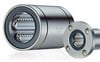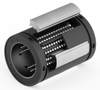

Due to advances, square rails and round rails are now similar in price.
Engineers faced with a linear-motion application often turn to pre-engineered linear bearings and guides. But linear guides come in two basic shapes – round and square – and designers often struggle with which type to use. Square or profile rails once cost significantly more than round because the former need extensive grinding that is inherent to the design. But recent manufacturing advances and economies of scale let square rails now compete with round in a broad range of applications.
The criteria for choosing one over the other are no different than choosing any other machine component: define system objectives, then consider factors such as load capacity, stiffness, accuracy, smoothness, size, and overall costs. The best place to start is to look at the fundamental qualities of each type of guide.