Understanding Ultrasonic Sensing
Featured Product from Migatron Corporation
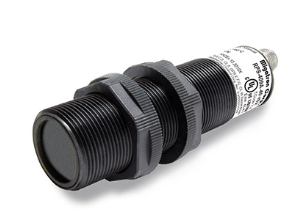
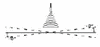
Understanding Ultrasonics Ultrasonic Sensing/Control Basics Ultrasonic signals are like audible sound waves, except the frequencies are much higher. Our ultrasonic transducers have piezoelectric crystals which resonate to a desired frequency and convert electric energy into acoustic energy and vice versa. The illustration shows how sound waves, transmitted in the shape of a cone, are reflected from a target back to the transducer. An output signal is produced to perform some kind of indicating or control function. A minimum distance from the sensor is required to provide a time delay so that the “echoes” can be interpreted. Variables which can effect the operation of ultrasonic sensing include: target surface angle, reflective surface roughness or changes in temperature or humidity. The targets can have any kind of reflective form – even round objects.