
Fluid Feedthroughs
Last Updated: April 1, 2025
Description
Fluid feedthroughs are designed to transmit fluids into high and ultrahigh vacuum environments or pressurized systems through a hermetic seal. They are typically used to pass fluids such as air, water, process gases, and liquid nitrogen through the walls of vacuum systems to cool the entire system. There are two main types of fluid feedthroughs: those for general service and those for cryogenic applications.
Working Principle
Fluid feedthroughs operate by creating a hermetic seal that allows fluids to pass through the walls of vacuum systems without compromising the vacuum environment. General service fluid feedthroughs are usually of single-walled construction and use water or gases as the cooling medium. Cryogenic service feedthroughs, on the other hand, are designed with dual walls and coaxial tube construction to handle extreme thermal gradients. The coaxial cavity between these tubes acts as a thermal barrier, reducing condensation and ice buildup, which is crucial for maintaining system integrity and preventing potential failures.
Applications
Fluid feedthroughs are used in various applications where maintaining a vacuum environment is critical. For example, in cryogenic applications, they are essential for passing liquid nitrogen through vacuum systems to provide cooling. They are also used in industrial processes that require the transmission of process gases or cooling water into vacuum chambers.
Advantages over other Feedthroughs
Fluid feedthroughs offer specific advantages in applications requiring the transmission of fluids under vacuum conditions. Their ability to maintain a hermetic seal while allowing fluid transmission makes them superior in applications where maintaining a vacuum is crucial. The dual-wall and coaxial tube design of cryogenic feedthroughs provide an added advantage by minimizing thermal losses and preventing ice buildup, which can be a significant issue with other types of feedthroughs.
Limitations
One limitation of fluid feedthroughs is the potential for condensation and ice buildup, particularly in cryogenic applications. This can lead to system clogging and potential failures if not properly managed. Additionally, the complexity of the dual-wall and coaxial tube design in cryogenic feedthroughs can increase the cost and maintenance requirements compared to simpler feedthrough designs.
Considerations
When selecting fluid feedthroughs, it is important to consider factors such as initial costs, operating expenses, durability, and maintenance requirements. The choice between general service and cryogenic feedthroughs will depend on the specific application requirements, including the vacuum level and the type of fluid being transmitted. The diameter of the tubing and the mounting holes are also critical considerations to ensure compatibility with the existing system. Durability and accuracy are essential for maintaining system integrity, while replacement and maintenance costs should be factored into the overall cost of ownership.

from Nor-Cal Products, Inc. - The Vacuum Experts
Liquid feedthroughs are a cost-effective and reliable way to introduce water into a vacuum system. The .035" single wall construction is designed for the transport of water as a cooling agent. [See More]
- Feedthrough Type: Fluid
- Temperature Range: -270 to 450
- Vacuum Rating: 9.91E-11
- Feedthrough Mount: Flange
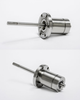
from Senior Aerospace Metal Bellows
Using a bellows design to provide a hermetic seal, the rotary feedthrough provides for rotary motion through a pressure boundary with zero leakage. This is suitable for use with gasses, liquids or vapor. The bellows construction provides leak tightness to 1 × 10⁻⁹ std cc/sec He. With no... [See More]
- Feedthrough Type: Fluid
- Feedthrough Mount: Flange
- Temperature Range: -40 to 149
from KENT Systems, LLC
Collection 1 4 port cross [See More]
- Feedthrough Type: Fluid
- Temperature Range: -45.6 to 121
- Vacuum Rating: 517

from CoorsTek
Ceramic microelectronic components are used in active and passive devices that enable high-performance electronics to be used in all kinds of environments and applications — in aerospace, automotive, communications, computers, medical, and a large variety of electronic instruments, industrial... [See More]
- Feedthrough Type: Electrical; Fluid
- Feedthrough Mount: Flange

from Nor-Cal Products, Inc. - The Vacuum Experts
Dual liquid nitrogen feedthroughs are constructed with dual coaxial tube geometries. This thermal barrier effectively reduces condensation and ice buildup on the atmosphere side of the feedthrough around the mounting flange interface, protecting the seal's integrity. This is necessary because of the... [See More]
- Feedthrough Type: Fluid
- Temperature Range: -270 to 450
- Vacuum Rating: 9.91E-11
- Feedthrough Mount: Flange

from Nor-Cal Products, Inc. - The Vacuum Experts
Liquid feedthroughs are a cost-effective and reliable way to introduce water into a vacuum system. The .035" single wall construction is designed for the transport of water as a cooling agent. [See More]
- Feedthrough Type: Fluid
- Temperature Range: -270 to 450
- Vacuum Rating: 9.91E-11
- Feedthrough Mount: Flange

from Nor-Cal Products, Inc. - The Vacuum Experts
Single liquid nitrogen feedthroughs are constructed with single coaxial tube geometries. This thermal barrier effectively reduces condensation and ice buildup on the atmosphere side of the feedthrough around the mounting flange interface, protecting the seal's integrity. This is necessary because of... [See More]
- Feedthrough Type: Fluid
- Temperature Range: -270 to 450
- Vacuum Rating: 9.91E-11
- Feedthrough Mount: Flange