
-
Supplier: Interstate Plastics, Inc.
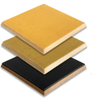
Description: struck, canvas phenolic can be used in explosion-proof environments. The material is commonly used to make gears, pulleys, rollers, and guides. Canvas phenolic is a mechanical grade and does not have electrical properties comparable to the ce grade. Canvas
- Overall Thickness: 0.125 to 2 inch
- Form / Shape: Film / Sheet
- Industry: General Industrial
- Features: Phenolics / Formaldehyde Resins (Melamine, etc.), Thermoset / Crosslinked
-
Supplier: Norplex-Micarta
Description: NP342 (NEMA C) consists of cotton sheeting and general-purpose phenolic resin. In terms of price and quality of machining, this material is an intermediate option between canvas and linen grades. The product is easy to machine and operates with less noise than metal. In
- Water Absorption: 1.8 %
- Tensile Strength (Break): 10,900 to 12,700 psi
- Form / Shape: Film / Sheet
- Features: Flame Retardant (e.g. UL 94 Rated), Other, Phenolics / Formaldehyde Resins (Melamine, etc.), Thermoset / Crosslinked, UL Approved
-
Supplier: RWM Casters Company
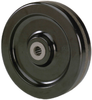
Description: APPLICATIONS Durastan Phenolic Wheels are made from macerated cotton canvas and mixed with a quality premium phenolic resin compound. They are molded under high pressure under controlled conditions to produce a maximum density, superior strength product. Durastan
- Load Capacity: 400 to 8,000 lbs
- Wheel Diameter: 3 to 18 inch
- Wheel Tread Width: 1.25 to 4 inch
- Hub Length: 1.46875 to 5.5 inch
-
-
Supplier: Total Plastics, Inc.
Description: 2-3/4” 2-3/4” 3” 3” 3-1/4” There are more than a thousand different sizes of phenolic tubing in many grades. To help you in fill your phenolic tubing requirements we list the most common sizes and grades in our inventory. For sizes not listed, please call for prices and availability.
- Chemical System: Phenolics
- Form / Shape: Plate, Rod / Round Stock
- Features: Thermoset / Crosslinked



Find Suppliers by Category Top
More Information Top
 Indicates content that may require registration and/or purchase.

-
INTRODUCTION TO INDUSTRIAL LAMINATES: Plastic Distributor & Fabricator
Phenolic Cotton Grades NEMA grades C, and CE Canvas Cotton -Cloth Reinforced Phenolic -- natural color is typically light tan to brown.
-
Machinery's Handbook 29 Complete Document
Historically, sturdy composites have been and are still made by compression molding multilayer canvas , paper, or cotton -felt sheets impregnated with phenolic or other thermosetting resins.
-
Phenoxy Resin—A New Thermoplastic Adhesive
tile, burlap, cement, chlorosulfonated polyethylene, cinder block, cork tile, cotton and canvas cloth, epoxy,* felt, glass and glass fiber, linear polyester, melamine plastics,^ paper, phenolic plas- tics,* poly(methyl methacrylate), poly- (vinyl fluoride), and vinyl/asbestos tile.
-
Industrial laminates: manufacture, materials, and applications
There are three weights of cotton fabrics which are used to make industriallaminatestoday: fine weave print cloths, commonly called linen, mediumweight and weave chafer, and heavier weight, 8 - 10 oz/yd2 canvases . NEMA Grades L and LE are made from linenwhich is impregnatedwith a phenolic resin binder.
-
Encyclopedic Dictionary of Polymers
Sailcloth \▐ sa¯(ә)l-▐ klo´th\ n (13c) Any heavy, strongly made woven canvas of cotton , linen, jute, polyester, nylon, aramid, etc., that is used for sails. A crystalline phe- nolic acid used especially in the form of salts and other derivatives as an analgesic and antipyretic.
-
Plastics: The Layman's Guide
… first appearing in the 1930s were usually composed of layers of paper with phenolic or amino resin … … of a treated textile fabric was Charles Mackintosh's 'mackintosh' of 1823, made from cotton cloth impregnated with … … variants include such diverse creations as industrial seals, flame-resistant conveyor belts in canvas with PVC, and …
-
THE BASICS: THERMOSET LAMINATES - ARE THEY FOR YOU?: Plastic Distributor & Fabricator
… of vulcanized laminates and one of the largest US distributors for canvas and fine weave canvas laminates. Laminated thermosetting products consist essentially of fibrous sheet materials such as cellulose paper, cotton fabric, glass fabric … … to provide a broad basis for the inclusion of thermosetting resins such as phenolic , melamine, silicone, polyester …
-
Journal of the Aeronautical Sciences (Institute of the Aeronautical Sciences) > Plastics as Structural Materials for Aircraft
In the usual molding composition the resins are mixed with ground or shredded fibrous fillers, such as wood flour, cotton flock, or comminuted canvas . Phenolic laminated ma- terials of this type have already found many applica- tions in the aircraft, automotive …