
-
Supplier: Saint-Gobain Tape Solutions
Description: PTFE films provide a conformable release surface and exhibit a remarkably low coefficient of friction and non-stick properties. PTFE films have high temperature resistance and are virtually unaffected by all chemicals. At elevated temperatures, PTFE film still retains excellent tensile
- Overall Thickness: 0.30314977 inch
- Overall Width / OD: 0.76771695 inch
- Diameter: 0.76771695 inch
- Type: Fiber / Monofilament, Strands / Multi-filament
-
Supplier: Saint-Gobain Tape Solutions
Description: PTFE films provide a conformable release surface and exhibit a remarkably low coefficient of friction and non-stick properties. PTFE films have high temperature resistance and are virtually unaffected by all chemicals. At elevated temperatures, PTFE film still retains excellent tensile
- Overall Thickness: 0.45275615 inch
- Overall Width / OD: 1.5354339 inch
- Diameter: 1.5354339 inch
- Type: Fiber / Monofilament, Strands / Multi-filament
-
Supplier: Saint-Gobain Tape Solutions
Description: PTFE films provide a conformable release surface and exhibit a remarkably low coefficient of friction and non-stick properties. PTFE films have high temperature resistance and are virtually unaffected by all chemicals. At elevated temperatures, PTFE film still retains excellent tensile
- Overall Thickness: 0.24409462 inch
- Overall Width / OD: 1.4173236 inch
- Diameter: 1.4173236 inch
- Type: Fiber / Monofilament, Strands / Multi-filament
-
-
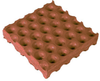
Supplier: Advanced Antivibration Components - AAC
Description: PAD: A compound of two layers of tough vinyl chloride elastomeric resin bonded to both sides of a strong reinforcing core of monofilament fiberglass and fused in a special process. COLOR: Orange COEFFICIENT OF FRICTION: .8 FOR STANDARD LOADS OF: 50 to 100 psi (3.5 to 7 kgf/cm2)
- Height or Thickness (Before loading): 0.625 inch
- Type: Dampening Pad
- Application: Vibration Isolation
-
Supplier: Bando American, Inc.
Description: synchronization from both sides of the belt. Tough nylon fabric on both sides of the belt protects teeth against wear and abrasion. Low coefficient of friction provides smooth running characteristics.
- Belt Width: 0.25 to 3 inch
- Number of Teeth: 37 to 340
- Features: Double-Sided, Other / Custom Imperial Pitch
- Belt Material: Neoprene
-
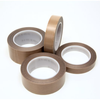
Supplier: Can-Do National Tape
Description: 3M 5451 PTFE Glass Cloth Tape has a brown woven glass cloth backing impregnated with PTFE (polytetrafluoroethylene). This tape provides a slick surface on process machinery and offers an extremely low coefficient of friction which, in combination with a pressure sensitive silicone
- Thickness: 0.0056 inches
- Peel Strength / Adhesion: 2.375 lbs/in
- Temperature Resistance: -73 to 260 C
- Features: Adhesive, Protective Tape
-
Supplier: item America, LLC
Description: fiber-glass reinforced plastic. It is safely concealed in the groove of a Profile 8 light and exhibits high rigidity and low coefficients of friction. The plastic ensures stability, smooth travel and corrosion resistance. The slide runs on a high-strength Double-Bearing Unit and
- Stroke or X-Axis Travel: 223.5434278 inch
- Rated Speed: 118.110236220472 in/sec
- Carriage Load: 78.68 lbs
- Orientation: Gantry, Horizontal, Inverted, Vertical
-
Supplier: SlipNOT Metal Safety Flooring
Description: SlipNOT® anti-slip stainless steel ladder rungs provide essential OSHA ladder safety where sanitation and durability is required. Stainless steel ladder rungs exceed all requirements for coefficient of friction specified by ANSI, ASTM, ADA, NFPA and OSHA (OSHA standard 1910.26





Find Suppliers by Category Top
Featured Products Top
-
 roughness. Abrasion is a type of wear that causes the material to deteriorate by means of friction when they rub or slide against each other. Friction is a measure of the resistance to motion and loss of energy when two surfaces interact. The coefficient of friction is a term that measures (read more)
Browse Datasheets for Osborne Industries, Inc. -
reinforced composite construction process to ensure that it achieves a low coefficient friction result, whilst remaining dimensionally stable when used under water - meaning it does not swell and absorbs little water. Using our filament winding process the liner and fiberglass backing are wound (read more)
Browse Plain Bearings and Sleeve Bearings Datasheets for GGB -
absorption, making it ideal for hydropower and industrial applications. How are they made? The composite bearing is made using our fibre reinforced composite construction process to ensure that it achieves a low coefficient friction result, whilst remaining dimensionally (read more)
Browse Plain Bearings and Sleeve Bearings Datasheets for GGB
More Information Top
 Indicates content that may require registration and/or purchase.

-
http://dspace.mit.edu/bitstream/handle/1721.1/93429/81rr024_full.pdf?sequence=1
friction coefficient of fiberglass on copper was taken at 0.30, which is .
-
Failure Analysis Of Synathetic Insulators With Fiberglass Rod Submitted To Mechanical Loads
End Fitting- fiberglass Coefficient of Friction .
-
Fiberglass and Glass Technology
The very high coefficients of friction of fiber- glass , filament-to-filament and filament-to-contact surfaces, require that lubricants be a component of the size.
-
Hertzian Fracture, Kinetic Friction and the Mechanical Impact LOX Compatibility Testing of Polymers and Polymer Matrix Composites
͓200͔Stone, E. and Young, W., “ Coefficient of Friction Measurements of Fiberglass /Epoxy at Cryogenic Temperatures,” Advances in Cryogenic Engineering Materials, Plenum, New York, 1980, Vol. 26, pp. 315–318.
-
Bibliography
The kinetic friction for steel on basalt increased by a constant adhesion, while for both titanium and fiberglass the coefficient of kinetic friction in- creased appreciably while the adhesion decreased slightly.
-
Horizontal Core Acquisition and Orientation for Formation Evaluation
Fiberglass has a low coefficient of friction , is extremely dura- ble, and is flexible enough to prevent jamming.
-
Large Diameter Sewer Rehabilitation by Sliplining in Florida
… of an inserted pipe material such as a fiberglass or plastic liner would, of course, reduce the cross-sectional area of flow but, due to the extremely smooth flow characteristics of fiberglass , the friction factor or roughness coefficient is lower which results …
-
Adhesion bond and temperature stresses at the polymer - filler interface in polyethylene composites
Since the coefficient of friction of polyethylene relative to fiberglass is equal to 0.3, the force of friction is approximately 9 kgf/cm2.
-
Green Tribology
Furthermore, comparing the two graphs, it is noticeable that the friction minimum is shifted to lower speeds and that the minimum with the fiberglass insulation is characterized by a higher friction coefficient than is the case for the noninsulated Stellite 6B slider …
-
http://www.cropj.com/gharibzahedi_5_4_2011_473_478.pdf
Static friction coefficient on plywood, galvanized steel sheet and fiberglass were 0.38, 0.33 and 0.27, respectively, while the dynamic angle of repose on plywood, galvanized steel sheet and fiberglass were 25.53˚, 21.74˚ and 16.31˚, respectively.