
-
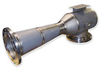
Supplier: Schutte & Koerting
Description: Ejector Venturi Gas Scrubbers are very effective at removing noxious gases, particulates, odors, fumes, and dusts from gas streams. Particulate contaminants are removed through impaction by the high-velocity spray of scrubbing liquid. Gases and odors are eliminated
- Airflow: 5 to 100,000 SCFM
- Minimum Particle Size Filtered: 5 to 40 µm
- Pollutants Scrubbed: Ammonia, Caustic, Chlorine Gas
- Filter Type: Venturi
-
Supplier: IHS ESDU
Description: ESDU 85032 provides procedures for the design and performance prediction of ejectors and jet pumps where both the primary and secondary streams are liquid.The first procedure obtains an optimum design for a required duty, and the second predicts performance of an existing
-
Supplier: Schutte & Koerting
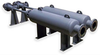
Description: Single-Stage Steam Jet Ejectors are based on the ejector-venturi principle. In operation, steam issuing through an expanding nozzle has its pressure energy converted to velocity energy. A vacuum is created and the high velocity of steam entrains air or gas and the mixture of
- Ultimate Operating Vacuum: 710 to 0 torr
- Application: Analytical / Scientific, Chemical / Corrosive Gas, Food Processing, General Purpose / Industrial, Manufacturing Processing, Medical / Laboratory, Packaging, Pharmaceutical / Sanitary, Power Generation, Semiconductor Manufacturing
- Venturi Type: Liquid Eductor / Ejector, Steam Ejector, Venturi Air Jet
- Features: Other
-
-
Supplier: Schutte & Koerting
Description: Ejectors consist of a booster ejector, a booster condenser, and a Two-Stage Ejector consisting of a high-vacuum ejector, intercondenser, and low vacuum ejector. In some applications another condenser (after-condenser) can be used at the low vacuum ejector
- Ultimate Operating Vacuum: 759.5 to 0 torr
- Application: Analytical / Scientific, Chemical / Corrosive Gas, Food Processing, General Purpose / Industrial, Manufacturing Processing, Medical / Laboratory, Packaging, Pharmaceutical / Sanitary, Power Generation, Semiconductor Manufacturing
- Features: Four or More Stages, Other
- Venturi Type: Liquid Eductor / Ejector, Steam Ejector, Venturi Air Jet
-
Supplier: IHS ESDU
Description: ESDU 86030 gives step-by-step calculation procedures, based on performance charts, for the optimum design of steam/liquid and steam/gas ejectors. For steam/gas ejectors the data are derived from a wide range of experimental results, but for steam/liquid
-
Supplier: SAE International
Description: gas-liquid two phase flow), improved design of each ejector part, and improved internal flow distribution inside the evaporator. The ejector is integrated into the tank of evaporator like the previous generation, so there is no impact to vehicle packaging space. Test
-
Supplier: Schutte & Koerting
Description: Steam Jet Blowers utilize the ejector-venturi principle to move large volumes of air and other gases against low back pressures. The Steam Jet Blower normally utilizes high-pressure steam as the motive force, but compressed air or gas at 15 psig or higher can also be used. They are
- Venturi Type: Liquid Eductor / Ejector, Steam Ejector, Venturi Air Jet
-
Supplier: Travaini Pumps USA
Description: Pumps are provided with threaded connections for service liquid, pump draining, anticavitation valve. Pumps are also provided, by request, with flanged air-liquid separator tank, non return valve, ejector, vacuum relief valve, valve to control the flow of the liquid
- Ultimate Operating Vacuum: 30 torr
- Pumping Speed: 14.7 CFM
- Motor Power: 1.5 HP
- Application: Chemical / Corrosive Gas, Food Processing, General Purpose / Industrial, Pharmaceutical / Sanitary, Semiconductor Manufacturing
-
Supplier: Travaini Pumps USA
Description: Pumps are provided with threaded connections for service liquid, pump draining, anticavitation valve and companion flanges. Pumps are also provided, by request, with flanged air-liquid separator tank, non return valve, ejector, vacuum relief valve, flow valve to control the flow
- Ultimate Operating Vacuum: 100 torr
- Pumping Speed: 29.4 CFM
- Motor Power: 3 HP
- Application: Chemical / Corrosive Gas, Food Processing, General Purpose / Industrial, Pharmaceutical / Sanitary, Semiconductor Manufacturing
-
Supplier: Twin City Fan & Blower
Description: air. Typical applications include combustion air, pressure and vacuum drying, product cooling, primary air supply to ejectors, liquid agitation, glass blowing and cooling, water blow-off, air pollution control systems, exhausting, pneumatic conveying and gas boosting.
- Air Flow Rate: 700 to 75,000 SCFM
- Static Pressure: 506.78716749245723 in H2O
- Maximum Diameter (Fan or Blower Wheel): 27 to 73 inch
- Applications / Use: Air Handling Units / HVAC, Pressure / Pressurization Blower
-
Supplier: DME Company
Description: Slide Sensors are used to Monitor and Control Injection Molding Cavity Pressure. Slide Sensors are usually installed under an ejector pin. The entire assembly can be Slid out of a Mold and a Blank Sensor Installed for sampling applications. SSC-10 Slide Sensor Extension Cable connects the
- Working Pressure Range: 0 to 20,000 psi
- Accuracy: 0.75 ±% FS
- Operating Temperature: 0 to 450 F
- Measurement Type: Absolute
-
Supplier: Lowara
Description: Self-priming close-coupled centrifugal pumps with built-in ejector system, designed to remain primed even in the presence of water-dissolved gases. The extensive use of pressed stainless steel ensures a high-performance, durable and lightweight pump. Suitable for use with drinking water.
- Horsepower: 0.495881542414043 to 1.4742424233931 HP
- Maximum Discharge Flow: 18.49204 GPM
- Maximum Discharge Pressure: 116.03016 psi
- Media Temperature: 14 to 104 F
-
Supplier: Fuji Impulse America Corp.
Description: attached to the top clamping lever where it is less likely to be exposed to liquids. The V-401NTW series of sealers employs the ejector-vacuum method, which uses the flow of compressed air to directly eject the gas inside the bag to the outside of the machine. Unlike the vacuum
- Packaging: Bag / Pouch
- Closing Method: Heat Seal
- Industry: Industrial / General Use
- Goods: Liquid, Powder / Granular
-
Supplier: Branch Environmental Solutions
Description: the liquid sprayed into the Venturi to create a pull on the gas drawing it into the scrubber. The gas and liquid are then mixed in both the spray section and in the high velocity Venturi throat. There are many applications for Jet Venturi scrubbers. One example is
- Airflow: 50,008.05 SCFM
- Pollutants Scrubbed: Caustic
- Process Type: Wet
- Filter Type: Wet Spray






Find Suppliers by Category Top
More Information Top
 Indicates content that may require registration and/or purchase.

-
Interfacial area and mass transfer coefficients in liquid-gas ejectors
Simultaneous aspiration and dispersion of the entrained fluid takes place in the cocurrent gas liquid ejector systems, which causes continuous formation of fresh interface and hence the generation of large inter facial area [1].
-
Simulation of the test stand gas-liquid ejector operation
This technique uses the tailor-made test stand (Fig. 1); one of the basic elements of which is the gas liquid ejector (GLE) [1].
-
Bubble size measurement and error analysis in a gas liquid ejector - ePrints@IISc
Bubble size measurement and error analysis in a gas liquid ejector .
-
Bubble size measurement in a gas-liquid ejector for a sodium chloride-air system - ePrints@IISc
A high speed photographic technique has been employed to measure the Sauter mean diameter of bubbles experimentally in a gas liquid ejector using a sodium chloride-air system.
-
Holdup measurement in a gas-liquid ejector for a sodium chloride-air system - ePrints@IISc
Holdup measurements have been carried out experimentally using gamma ray attenuation method in-a gas liquid ejector for a sodium chloride-air system.
-
NISCAIR ONLINE PERIODICALS REPOSITORY (NOPR) : Bubble size measurement and error analysis in a gas liquid ejector
Bubble size measurement and error analysis in a gas liquid ejector .
-
NISCAIR ONLINE PERIODICALS REPOSITORY (NOPR) : Holdup measurement in a gas-liquid ejector for a sodium chloride-air system
Holdup measurements have been carried out experimentally using gamma ray attenuation method in a gas liquid ejector for a sodium chloride-air system.
-
Formation of an air‐water two‐phase flow
Witte, J. H., “Efficiency and Design of Liquid Gas Ejectors ,” Brit.Chem.Eng., 10, 602 ( 1965).
-
Scientific.Net: Materials Science
Abstract: Liquid gas ejector uses liquid as the motive fluid and gas as the entrained fluid.
-
Scientific.Net: Materials Science
Abstract: Liquid gas ejector uses liquid as the motive fluid and gas as the entrained fluid.