
-
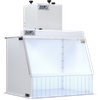
Supplier: Sentry Air Systems, Inc.
Description: This 30” Wide Ductless Fume Hood combines powerful air flow with a sturdy and compact enclosure for optimal respiratory and environmental protection. This fume hood protects the operator and environment from hazardous fumes or particulate generated from applications performed within
- Required Airflow: 350 SCFM
- Filter Type: Ductless
- Fume Hood Type: General Purpose
-
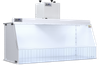
Supplier: Sentry Air Systems, Inc.
Description: This 60” Wide Ductless Fume Hood combines powerful air flow with a sturdy and compact enclosure for optimal respiratory and environmental protection. This fume hood protects the operator and environment from hazardous fumes or particulate generated from applications performed within
- Required Airflow: 350 SCFM
- Filter Type: Ductless
- Fume Hood Type: General Purpose
-
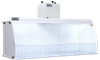
Supplier: Sentry Air Systems, Inc.
Description: This 70” Wide Ductless Fume Hood combines powerful air flow with a sturdy and compact enclosure for optimal respiratory and environmental protection. This fume hood protects the operator and environment from hazardous fumes or particulate generated from applications performed within
- Required Airflow: 350 SCFM
- Filter Type: Ductless
- Fume Hood Type: General Purpose
-
-
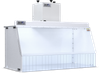
Supplier: Sentry Air Systems, Inc.
Description: This 50” Wide Ductless Fume Hood combines powerful air flow with a sturdy and compact enclosure for optimal respiratory and environmental protection. This fume hood protects the operator and environment from hazardous fumes or particulate generated from applications performed within
- Required Airflow: 350 SCFM
- Filter Type: Ductless
- Fume Hood Type: General Purpose
-
Supplier: NETZSCH Premier Technologies LLC
Description: immersion tube. With a NETZSCH cyclone you can achieve a degree of separation of up to 99.9%* depending on the product and fineness. * Example: Product density = 7.87 g/cm3, fineness d97 = 11.2 µm Executions with NETZSCH Cyclones With spiral hood for vortex-free gas outlet and conditioning
- Separation / Filtration System: Cyclone (Centrifugal) Separators
- Process: Dry
- Applications: Fine Powders
- Collector Type: Stationary
-
Workbenches and Workstations (Industrial) - Classroom Demonstration Workstation -- TeachAide™ ACTA48Supplier: AirClean Systems
Description: toxic fumes, vapors, particulate, or smoke. Teachaide™ Demonstration Fume Hoods have been independently tested to the educational science laboratory curriculum. Each demonstration workstation is factory tested and shipped fully assembled with filters installed. AirClean® Systems
- Length: 25 inch
- Width: 48 inch
- Type: Cleanroom / Lab Workstation
- Features: Other, Specialty / Other



Find Suppliers by Category Top
Featured Products Top
-
 appropriate. Similar to a ductless system, contaminated air should be filtered or scrubbed prior to air exhaust into the environment. The HEPA filtered incoming air in ducted vertical flow hoods provides the added benefit of protecting the cleaned and rinsed parts or instruments from dust and other (read more)
Browse Cleaning Agents and Surface Treatments Datasheets for AirClean Systems -
Laboratories (UL). When combined with a hose-proof hood (accessory), the Filter Fan Plus series achieves protection type IP56. But the Filter Fan Plus series also proves its worth in ongoing operation, as the minimal use of filters in the filter fan systems reduces maintenance costs. (read more)
Browse Electronic Cooling Fans Datasheets for STEGO -
/sterilization, medical/healthcare, pharmaceuticals, laboratories, semiconductor disinfection, imaging for forensics, and manufacturing. UVC light effectively kills bacteria, viruses, and other pathogens. Selecting the correct UV light bulb ensures the highest quality, effectiveness (read more)
Browse UV Disinfection and UVGI Sanitization Systems Datasheets for AirClean Systems
More Information Top
 Indicates content that may require registration and/or purchase.

-
Hanford Works monthly report, October 1950
Laboratory detected product contamination on llnt and dust found around the laboratory hoods and under benches.
-
Exhausting Process Dust: Grain Processing Corp., Muscatine, IA
This technology, applied to Grain Processing Corp. uses mixed flow impeller technology to manage process dust -and laboratory workstation fume hood exhaust roof exhaust systems, is widely used at research laboratories to handle workstation fume hood exhaust emissions.
-
Chemical Processing Department monthly report, September 1957
story waste tan_, and the replacement of four dust stop filtersin _arious laboratory hoods .
-
Hanford Works monthly report, November 1950
Laboratory for removing dust and lint from hoods and bench tops.
-
Nonwoven Fabrics
Air filtration products include large baghouse filters, flue gas scrubbers, smaller vacuum bags and dust filters, frame presses, laboratory hood filters, air-conditioning and air intake/output filter covers, respirator pads, industrial masks and filters and clean-room filter systems.
-
Effect of Low-Moisture Anhydrous Ammonia (LMAA) Pretreatment on Biomass Quality and Enzymatic Hydrolysis for Long-Term Storage
After harvest, the corn stover was washed with deionized (DI) water to remove impurities from biomass including soil and dusts and air-dried in a laboratory fume hood at ambient temperature.
-
Standoff detection results with the infrared hyperspectral MoDDIFS sensor
The difluoroethane was ejected from a small dust -off can under an operating laboratory fume hood .
-
Toxicity of flue gas components from cement plants in microalgae CO2 mitigation systems
Small amounts of dust (3 g), thinly spread under a laboratory safety hood , were sterilized by 30 min of UVexposure before preparing stock solutions of 1,000 ppm in the corresponding media (BG11 or BG11-S).
-
Survey of Gas Decontamination Problems at Installations of the Atomic Energy Commission
A project-wide problem is the proper desi^ of laboratory hoods which includes provision for removal of not only dusts (see Section III below), but also many of the radioactive gases which vs^j be evolved in the hoods.
-
Application of biometeorological concepts to health, comfort, and energy conservation in the laboratory
Laboratory hoods are the most commonly used means of removing dusts , gases, vapours, and fumes from laboratory operations.