
-
Supplier: PCE Instruments / PCE Americas Inc.
Description: PCE-MM 200UV is a UV USB inspection camera, or UV USB microscope, that magnifies objects up to 200 times. This UV inspection camera uses 8 UV LEDs with a wavelength of 365 nm for illumination. The inspection camera captures photos and videos as well as displays magnified
- Horizontal Resolution: 1,200 lines
- Maximum Frame Rate: 30 fps
- Width / Diameter: 1.2992133 inch
- Length: 4.330711 inch
-
Description: Thermo Scientific* CIDI3710D-UV is a gated intensified UV-sensitive, CID-based camera consisting of CID3710D solid-state RS-170 camera, fiberoptically coupled to 18mm second generation UV-sensitive microchannel plate image intensifier. Solid-state video monochrome video
- Horizontal Resolution: 776 lines
- Maximum Frame Rate: 30 fps
- Sensitivity: 0.000005381955 Lux
- Vertical Resolution: 512 lines
-
Supplier: ECOPTIK (CHANGCHUN) LTD
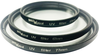
Description: an ultraviolet filter. Because too much ultraviolet light will affect the image quality, it is one of the must-haves for traditional photographers, but for the owners of digital video cameras and digital cameras. Said, because it is a CCD photosensitive element
- Type: Specialty / Other
-
-
Supplier: Instrument Technology, Inc.
Description: ITI UVU Ultraviolet Video Inspection System especially for inspecting internal surfaces of aircraft landing gear. Designed to eliminate the need for mirrors or bulky UV lamps, the "UVU" system increases reliability and decreases inspection time. It is ideal for viewing inside many
- Tube or Sheath Diameter: 28.6 mm
- Working Length: 1.1 to 2.3000000000000003 m
- Field of View: 100 degrees
- Minimum Focus Distance: 12.700000000000001 mm
-
Supplier: Kyocera Corporation
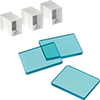
Description: aperture used for single lens reflex digital still camera • Flexible design depending on each separation pattern Applications • Digital still camera • Digital video camera • Security camera • Digital camera for industrial use • LCD projector
- Diameter, Square Side, or Rectangular Length: 5.079997256801482 to 12.699993142003704 mm
- Transmission Range: 350 to 1,100 nm
- Filter Type: Bandpass / Interference Filters
- Features: Infrared (IR), Ultra-Violet (UV), Visible (VIS)
-
Supplier: Shenzhen Vsndt Co., Ltd.
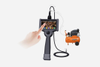
Description: illumination / LED illumination Fast interchangeable different types of probe Support WIFI(Optional) 6mm、8mm Probe for optional Megapixel HD camera 5" HD large screen Modular battery,Working time ≥ 4 hours UV optical fiber illumination Function: Video recording function Photograph
- Tube or Sheath Diameter: 1.2000000000000002 to 8 mm
- Working Length: 1 to 10 m
- Field of View: 90 to 140 degrees
- Operating Temperature: -4 to 158 F



Find Suppliers by Category Top
Conduct Research Top
-
Flare Gas Monitoring Systems (.pdf)
distribution infrastructure, and landfills. In many cases, federal or state EPA regulations require the monitoring of a stack's flame, or the pilot flame that ignites the gases, to avoid having unburned hydrocarbons enter the atmosphere. IR video cameras are an ideal monitoring tool, since they allow
More Information Top
 Indicates content that may require registration and/or purchase.

-
SR-71 Ship #1 - Ultraviolet Experiment
Mounted in the nose of the SR-71 was an ultraviolet video camera aimed skyward to capture images of stars, asteroids and comets.
-
Ultraviolet Radiation in the Solar System
An ultraviolet video camera was mounted in the nose of the plane to observe comets and stars.
-
SR-71A in Flight with Test Fixture Mounted Atop the Aft Section of the Aircraft
An upward-looking ultraviolet video camera placed in the SR-71's nosebay studied a variety of celestial objects in wavelengths that are blocked to ground-based astronomers.
-
SR-71B - in flight over snow-capped mountains
An upward-looking ultraviolet video camera placed in the SR-71's nosebay studied a variety of celestial objects in wavelengths that are blocked to ground-based astronomers.
-
SR-71 in flight with full afterburner
Mounted in the nose of the SR-71 was an ultraviolet video camera aimed skyward to capture images of stars, asteroids and comets.
-
SR-71 Pilot Stephen (Steve) D. Ishmael
An upward-looking ultraviolet video camera placed in the SR-71's nosebay studied a variety of celestial objects in wavelengths that are blocked to ground-based astronomers.
-
SR-71 flyover
From the nosebay of the aircraft, an upward-looking ultraviolet video camera studied a variety of celestial objects in wavelengths that are blocked to ground-based astronomers.
-
SR-71 Blackbird
From the nose bay of the aircraft, an upward-facing ultraviolet video camera recorded data on celestial objects in wavelengths blocked to ground-based as- tronomers by Earth’s atmosphere.
-
Happy
Other experiments included those on a laser air-data collection system, an upward-looking ultraviolet video camera to study celestial objects in wavelengths blocked to ground-based astronomers, atmospheric ozone research, satellite communications, and development of a linear aerospike rocket engine.
-
NASA
From the nosebay of the aircraft, an upward-looking ultraviolet video camera studied a variety of celestial objects in wavelengths that are blocked to ground-based astronomers.