Optical Add/Drop Multiplexers Information
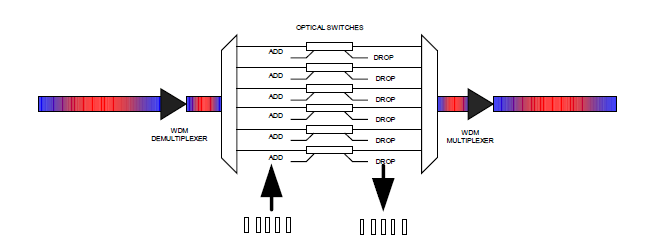
Optical Add/Drop Multiplexers (OADMs) are used in wavelength-division multiplexing systems for multiplexing and routing fiber optic signals. They selectively add and drop individual or sets of wavelength channels from a dense wavelength division multiplexing (DWDM) multi-channel stream. OADMs are used to cost effectively access part of the bandwidth in the optical domain being passed through the in-line amplifiers with the minimum amount of electronics.
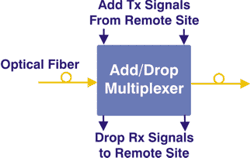
OADM. Image Credit: fiber-optics.info
The devices have passive and active modes depending on the wavelength. In passive OADM, the add and drop wavelengths are fixed beforehand while in dynamic mode, OADM can be set to any wavelength after instillation. Passive OADM uses thin-film interference filters, fiber gratings, and planar waveguides in networks with WDM systems. Dynamic OADM can select any wavelength by provisioning on demand without changing its physical configuration. It is also less expensive and more flexible than passive OADM. Dynamic OADM is separated into two generations as described in the table below.
|
Generation* |
I |
II |
III |
|
Configuration |
Passive OADM |
Dynamic OADM |
|
|
Add/Drop wavelength Number of wavelength |
Fixed |
Settable by provisioning Automatic change of connection by optical SW with provisioning |
|
|
Connection to electrical nodes (client) |
Manual change of fiber connections |
||
|
Network protection |
SONET/ SDH APS |
Optical layer APS |
|
|
Network architecture |
Linear |
Linear |
Linear, ring OBLSR/OBPSR |
|
Key devices |
Fiber grating Dielectric filter |
Optical SW, AOTF Tune-able wavelength LD |
|
Table Credit: FUJITSU Sci. Tech. *All acronyms defined at bottom of description.
Types of Optical Add/Drop Multiplexers
There are two types of OADMs, Configurable Optical Add Drop Multiplexers (COADM) and Reconfigurable Optical Add Drop Multiplexers (ROADM).
Configurable (or Fixed) Optical Add Drop Multiplexers (COADM or FOADM) are used to drop or add data signals on dedicated WDM channels. FOADMs have pre-assigned channels at static nodes and allowed adding and dropping of individual or multiple wavelength channels from a DWDM. COADMS allow the manufacturer to customize the number of channels, filter specifications, and power equalization but require excessive transporters at each node.
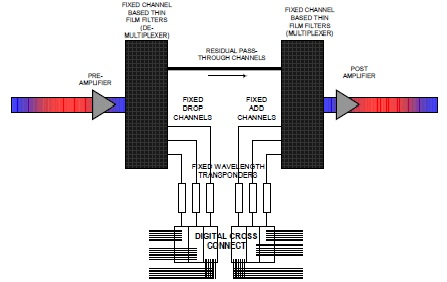
FOADM. Image Credit: Ashwin Gumaste
Reconfigurable Optical Add Drop Multiplexers (ROADM) can add, block, pass or redirect modulated infrared (IR) and visible light beams of various wavelengths in a fiber optic network. A laser tuned to a particular wavelength is able to electronically alter the selected channel routing through the optical network. This type of OADM provides flexibility in rerouting optical streams, bypassing faulty connections, allowing minimal service disruption and the ability to adapt or upgrade the optical network to different WDM technologies.
ROADM. Image Credit: Ashwin Gumaste
Definitions
AOTF - Acousto optic tune-able filter
SONET - Synchronous optical networking
SDH - Synchronous digital hierarchy
APS Automatic protection switching
OBLSR - Optical bidirectional line switch ring
OBPSR - Optical bidirectional path-switched ring
SW - Standing wave
LD - Laser diode
WDM - wavelength division multiplexers
Resources
Optical add/drop multiplexing architecture for metro area networks
ROADM (reconfigurable optical add-drop multiplexer)
Future of Optical Networks From Uncertainties to Opportunities (pdf)