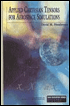
Applied Cartesian Tensors for Aerospace Simulation
In this chapter I discuss the mathematical descriptions of a system of N mass points. I have grouped these analyses into two general areas for study: 1) the motion of a system of mass points which form a rigid body and define the equations for rigid body dynamics, and 2) the motion of N independent mass points, as in planetary motion, which becomes the N-Body problem of astrodynamics.
I begin by defining the center of mass of a rigid body and the constraints that are placed on the individual mass particles making up the rigid body. The kinetic energy of the rigid body is derived in tensor form, and in doing so the moment of inertia matrix is shown to be a second order tensor. Using the summation convention notation I derive the equations of motion for a rigid body in the conservative gravity field of a large planetary mass. With this analysis I derive Euler s rotational equations of motion, where I have included the effects of balanced spinning subbodies, such as the rapidly spinning parts of a jet engine.
The slight displacement of the center-of-gravity from the center-of-mass of a rigid body due to a gravity gradient is developed in matrix form. This displacement causes the space vehicle to feel the rotational effects due to the gravity gradient torques. The rigid body gravity gradient torques are also developed and are shown to be a function of the body-axis moment of inertia tensor.
Computing the orbits...