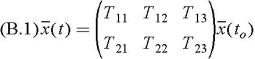
The following is a presentation of the C-W solution for the propagation of the LVLH relative motion of a space vehicle as seen from a space vehicle in circular orbit. This solution was derived by William Jackson at NASA Johnson Space Center39 and includes the constant accelerations that may be acting on the rendezvous space vehicle. The propagation equation is described in Eq. (2.143) of Sec. 2.4.2. The elements of the 6 9, T matrix are written here with six matrix partitions that are used in rendezvous and guidance applications as presented in Sec. 2.4.4. This notation also simplifies the understanding of details of the rendezvous GNC applications. The T matrix is formed by partitioning into 3 3 matrices, so that we can write Eq. (2.143) as
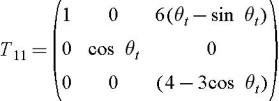
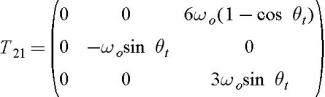
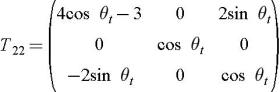
The propagation time is ? t = (t ? t o ) and ? o is the orbital rate as given in Eq. (2.151). Also let ?t = ?o ? t, and based on the partitions in Eq. (B.1), we have for position transition from initial position,
for position transition from initial velocity,
for position transition from the constant acceleration,
for velocity transition from initial position,
for velocity transition from initial velocity,
and finally for velocity transition from the constant acceleration,
Copyright The American Institute of Aeronautics and Astronautics, Inc. 2006 under license agreement with Books24x7


 TABLE OF CONTENTS