Asymptotic and Hybrid Methods in Electromagnetics

2.3: Creeping Waves on Elongated Objects

2.3 Creeping Waves on Elongated Objects

2.3.1 Introduction

Creeping waves play an important role in the process of high-frequency diffraction by a smooth convex body. Results presented in the preceding sections do not allow an explanation for some properties of creeping waves on strongly elongated bodies. Previously the asymptotic analysis was carried out in the supposition of single small parameter k ?1. If the body is strongly elongated another small parameter that measures the ratio of width to length may interfere with the asymptotic procedure.

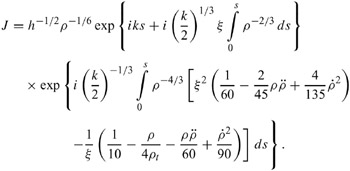
In the ordinary asymptotics of creeping waves one finds radius of transverse curvature only in smaller order corrections. For a magnetic transversally polarised wave on an axisymmetric perfect conductor, for example, these corrections appear in the phase factor of order O( k ?1/3) (see (2.49) in the previous section). The current J is given by

(2.94)

Here s, h and ? stand, respectively, for the arc-length, divergence and the radius of curvature of the geodesics and ? t is the radius of transverse curvature. The ? parameter is any zero of the equation


where w 1 is the Airy function.

If the transverse curvature is large and at the given frequency it is comparable to k 1/3, then the term with ? t in (2.94) appears to be of the same order as the leading term. This, generally speaking, signals that formula (2.94) loses its asymptotic character and may give wrong results for...

UNLIMITED FREE
ACCESS
TO THE WORLD'S BEST IDEAS

SUBMIT
Already a GlobalSpec user? Log in.

This is embarrasing...

An error occurred while processing the form. Please try again in a few minutes.

Customize Your GlobalSpec Experience

Category: Meniscus Lenses
Finish!
Privacy Policy

This is embarrasing...

An error occurred while processing the form. Please try again in a few minutes.