Asymptotic and Hybrid Methods in Electromagnetics

A hybrid diffraction coefficient is a combination of the diffraction coefficients corresponding to two types of diffraction phenomena.
We consider here the combination of edge diffraction with the launching of creeping waves or the reciprocal situation of a creeping wave diffracted by an edge.
The edge is either a discontinuity of the first derivatives of the surface coordinates (edge of a wedge) or a discontinuity of the second derivatives of the surface coordinates (line of discontinuity of the curvature). In both cases, we suppose that the faces involving surface diffraction are convex and that the source and the observation point are located far from the edge.
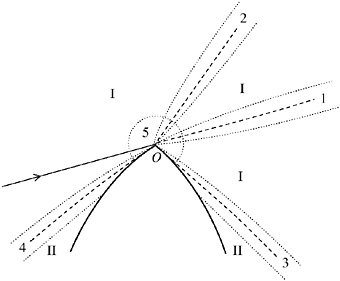
The field diffracted by the edge of a curved wedge undergoes several transition regions (which are also boundary layers), as shown in Figure 3.1.
For an incident ray, there are in general four transition regions in the far zone diffracted field. Since the shadow boundaries of the direct and reflected rays (regions 1 and 2) are also present in the canonical or modal problem of the straight wedge, the field in these regions has been deduced by Kouyoumjian and Pathak [1] from this model problem and is given by the uniform theory of diffraction (UTD).
For the shadow boundaries of the edge diffracted rays (regions 3 and 4) and the deep shadow region (region II), there is no model problem giving directly the analytical form of the solution in the far zone. However, in...