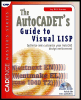
The AutoCADET's Guide to Visual LISP: Optimize and Customize Your AutoCAD Design Environment
What good is a computer if it cannot display the results of computations in a meaningful manner? Without the capability to display output, both as text and as graphics, Visual LISP would be useless to us. This chapter describes the essentials of Visual LISP output. I describe the components of the interface from a programmer's point of view and also introduce the primary subrs for generating output.
The main reason for programming in Visual LISP is to expand the capabilities of AutoCAD. And that is best accomplished by creating your own commands for AutoCAD. If you are the sole user of your programming effort, you are free to experiment with alternative input formats and command structures. But if you are writing code for others to use, the situation is less flexible. When writing code for other AutoCAD users, you need to make your interfaces appear like AutoCAD as much as possible. This is important for both input (the topic of the next chapter) and output.
Another thing to consider is the users relationship with the software. For example, if your program performs a large number of computations and requires extensive time to accomplish that task, you should output a message at regular intervals to let the operator know that the program is still running. Many Windows applications use a progress bar to indicate the status of the application. Unfortunately, Visual LISP cannot comply in that regard with ease (in some cases, you need more code to display...