Chemistry of Petrochemical Processes, 2nd Edition
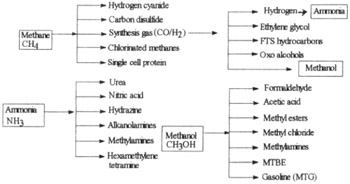
As mentioned in Chapter 2, methane is a one-carbon paraffinic hydrocarbon that is not very reactive under normal conditions. Only a few chemicals can be produced directly from methane under relatively severe conditions. Chlorination of methane is only possible by thermal or photo-chemical initiation. Methane can be partially oxidized with a limited amount of oxygen or in presence of steam to a synthesis gas mixture. Many chemicals can be produced from methane via the more reactive synthesis gas mixture. Synthesis gas is the precursor for two major chemicals, ammonia and methanol. Both compounds are the hosts for many important petrochemical products. Figure 5-1 shows the important chemicals based on methane, synthesis gas, methanol, and ammonia.1
A few chemicals are based on the direct reaction of methane with other reagents. These are carbon disulfide, hydrogen cyanide chloromethanes, and synthesis gas mixture. Currently, a redox fuel cell based on methane is being developed.2
Methane reacts with sulfur (an active nonmetal element of group 6A) at high temperatures to produce carbon disulfide. The reaction is endothermic, and an activation energy of approximately 160 KJ is required.3 Activated alumina or clay is used as the catalyst at approximately 675 C and 2 atmospheres. The process starts by vaporizing pure sulfur, mixing it with methane, and passing the mixture over the alumina catalyst. The reaction could be represented as:
Hydrogen sulfide, a coproduct,...