Deploying IP and MPLS QoS for Multiservice Networks
2.3: IP QOS Architectures

2.3 IP QOS Architectures

2.3.1 A Short History of IP Quality of Service

In order to understand the history of IP QOS architectures, we first need to define what an architecture means in this context. QOS architectures define the structures within which we deploy QOS mechanisms to deliver end-to-end QOS assurances or SLAs. To be completely defined, they need to provide the context in which mechanisms such as classification, marking, policing, queuing, and scheduling, dropping, and shaping are used together to assure a specified SLA for a service.

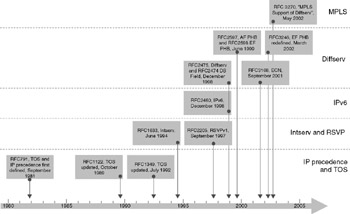
The standards which define the different architectures for IP QOS have been defined by the Internet Engineering Task Force (IETF, www.ietf.org). Figure 2.25 shows a timeline for the publication of the major IETF milestones in defining the QOS architectures for IP and MPLS.


Figure 2.25: IP QOS standards timeline

The following sections describe the evolution of IP QOS architectures from IP Precedence and Type of Service, through Integrated Services and Differentiated Services, and also describe how IP QOS architectures apply to MPLS.

2.3.2 Type of Service/IP Precedence

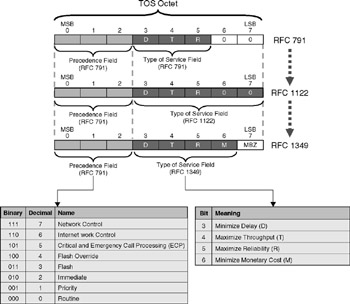
In 1981, the original IPv4 specification [RFC 791], defined an 8-bit field to be used for IP QOS classification; this was called the Type of Service octet. The type of service octet subsequently went through several stages of redefinition in [RFC 1122] and [RFC 1349], as shown in Figure 2.26.


Figure 2.26: Type of service octet evolution

Originally in RFC 791 the type of service octet was subdivided with 3 bits used for the IP...

UNLIMITED FREE
ACCESS
TO THE WORLD'S BEST IDEAS

SUBMIT
Already a GlobalSpec user? Log in.

This is embarrasing...

An error occurred while processing the form. Please try again in a few minutes.

Customize Your GlobalSpec Experience

Category: Network Processors
Finish!
Privacy Policy

This is embarrasing...

An error occurred while processing the form. Please try again in a few minutes.