Deploying IP and MPLS QoS for Multiservice Networks

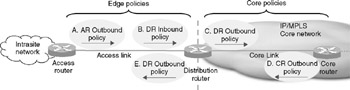
Diffserv is the most widely deployed QOS IP QOS architecture and hence most router QOS implementations are optimized for Diffserv deployments. In Section 2.2 we described the main data plane tools that are used in IP QOS: classification, marking, policing, queuing and scheduling, dropping, and shaping. In practice, which of these components are used and how they are combined to create a QOS policy depend upon where they are being applied in the network -at the edge or in the core - and whether they are being applied on egress to an interface or on ingress. Many networks are built with a hierarchy consisting of core routers (CRs), which provide connectivity between distribution routers (DRs), which in turn aggregate connections to routers at remote sites, each of which have local access routers (ARs). If, for example, we consider a Diffserv deployment in this type of network, as shown in Figure 2.38, the access link will normally be the edge of the Diffserv domain, with edge policies being applied outbound on the access router core facing interface and on the access facing interface of the distribution router (which may have inbound policies in some cases also); core policies are then typically applied outbound on the core facing interfaces of the distribution router and outbound on all core router interfaces.
As complex classification and conditioning is performed at the edge of a Diffserv network, router...