Derivative Instruments: A Guide to Theory and Practice

Chapter 2: Overview of Fixed Income Securities

In this chapter we present an introduction to fixed income analysis, particularly the pricing of default-free zero-coupon and coupon fixed-term bonds. Further reading is given in the bibliography. [1]

2.1 Basic Concepts

We are familiar with two types of fixed income security, zero-coupon bonds, also known as discount bonds or strips, and coupon bonds. A zero-coupon bond makes a single payment on its maturity date, while a coupon bond makes regular interest payments at regular dates up to and including its maturity date. A coupon bond may be regarded as a set of strips, with each coupon payment and the redemption payment on maturity being equivalent to a zero-coupon bond maturing on that date. This is not a purely academic concept witness events before the advent of the formal market in US Treasury strips, when a number of investment banks had traded the cash flows of Treasury securities as separate zero-coupon securities. [2]

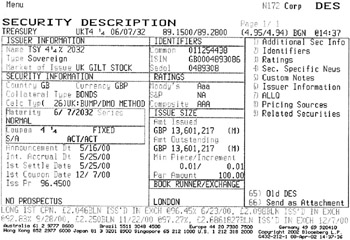
Bonds are described by their issuer name, coupon rate and term to maturity, and those that have fixed coupons and fixed maturity terms are known as conventional or vanilla bonds. An example of the basic description of a bond is given in Figure 2.1, the Bloomberg DES page.


Figure 2.1: Bloomberg screen DES for United Kingdom gilt, 4 1/4% Treasury 2032, as at 12 November 2002 Bloomberg LP. Used with permission.

The literature we review in this section is set in a market of default-free bonds, whether they are zero-coupon bonds...

UNLIMITED FREE
ACCESS
TO THE WORLD'S BEST IDEAS

SUBMIT
Already a GlobalSpec user? Log in.

This is embarrasing...

An error occurred while processing the form. Please try again in a few minutes.

Customize Your GlobalSpec Experience

Category: Corrosion Probes, Coupons, and Holders
Finish!
Privacy Policy

This is embarrasing...

An error occurred while processing the form. Please try again in a few minutes.