Derivative Instruments: A Guide to Theory and Practice
Put options (European-style) give the holder the right, but not the obligation, to sell a fixed number of shares of a named company at a fixed price on a specified date. Like their counterpart, the European call option, European puts can only be exercised at contract expiration.
Put options (American-style) give the holder the right, but not the obligation, to sell a fixed number of shares of a named company at a fixed price on or before a specified date.
The title American once again indicates the flexibility that the holder of the option has in deciding when to exercise the right to sell the underlying instrument at the selected strike price.
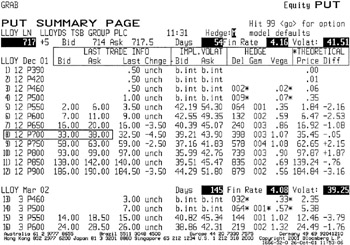
The interpretation of the put summary page (Figure 10.2) is analogous to that of the call table. The contract size is for 1000 shares. The quotes are all in terms of pence per share. So, by way of example, the premium to purchase a Dec 700 put is 38 pence per share and the contract for 1000 shares would cost 380.
Returning now to a more detailed look at the contents of the call and put tables, the question can be raised: what accounts for the differences in the costs of each contract?
It would appear that at 110 the Dec 600 put contract is a bargain compared to the 1280 that has to be paid for the Dec 600 call...