Designing a Wireless Network
A planning and analysis guide for designing the physical aspects of a wireless network.
 TABLE OF CONTENTS
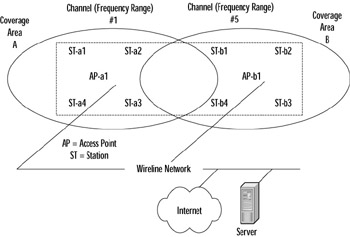
 The 802.11 architecture can best be described as a series of interconnected cells, and consists of the following: the wireless device or station, the access point (AP), the wireless medium, the distribution system (DS), the basic service set (BSS), the extended service set (ESS), and station and distribution services. All of these working together providing a seamless mesh gives wireless devices the ability to roam around the WLAN looking for all intents and purposes like a wired device.
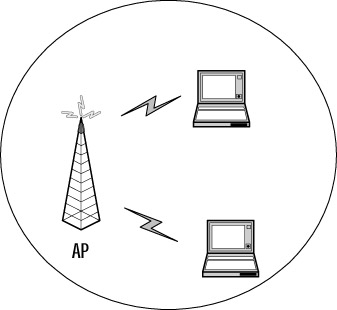
The core of the IEEE 802.11 standard is the basic service set (BSS). As you can see in Figure 4.7, this model is made up of one or more wireless devices communicating with a single Access Point (AP) in a single radio cell. If there are no connections back to a wired network, this is called an independent basic service set.
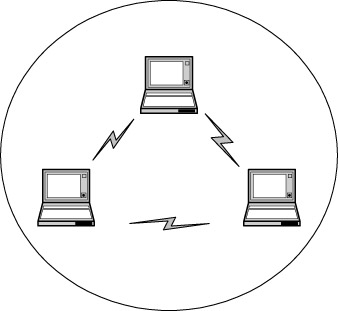
If there is no access point in the wireless network, it is referred to as an ad-hoc network. This means that all wireless communications is transmitted directly between the members of the ad-hoc network. Figure 4.8 describes a basic ad-hoc network.
When the BSS has a connection to the wired network via an AP, it is called an infrastructure BSS. As you can see in the model shown in Figure 4.9, the AP bridges the gap between the wireless device and the wired network.