Designing a Wireless Network
A planning and analysis guide for designing the physical aspects of a wireless network.
 TABLE OF CONTENTS
 The best way to describe mobile wireless is to call it your basic cellular phone service. The cell phone communications industry has migrated along two paths; the United States has generally progressed along the Code Division Multiple Access (CDMA) path, with Europe following the Global System for Mobile Communications (GSM) path. However, both areas cellular growth has progressed from analog communications to digital technologies, and both continents had an early focus on the voice communication technology known as 1G and 2G (the G stands for generations). Emerging technologies are focused on bringing both voice and data as well as video over the handheld phones/devices. The newer technologies are referred to as 2.5G and 3G categorically. A linear description of the evolution of these two technologies is presented in the following sections.
Figure 4.13 illustrates a generic cellular architecture. A geographic area is divided into cells; the adjacent cells always operate on different frequencies to avoid interference this is referred to as frequency reuse. The exact shape of the cells actually vary quite a bit due to several factors, including the topography of the land, the anticipated number of calls in a particular area, the number of man-made objects (such as the buildings in a downtown area), and the traffic patterns of the mobile users. This maximizes the number of mobile users.
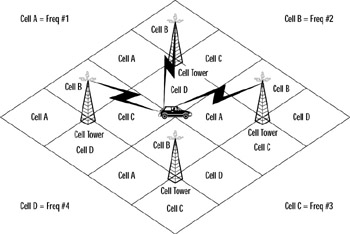
A lower powered antenna is placed at a strategic place, but it is not in the center of...