Designing Embedded Communications Software

The previous chapter provided an introduction to communications systems and some of the issues related to the software on those systems. This chapter investigates software in greater detail, starting with an introduction to host-based communications along with a popular framework for building host-based communications software the STREAMS environment.
Subsequently, we focus on embedded communications software detailing the real-time operating system (RTOS) and its components, device drivers and memory-related issues. The chapter also discusses the issues related to software partitioning, especially in the context of hardware acceleration via ASICs and network processors. The chapter concludes with a description of the classical planar networking model.
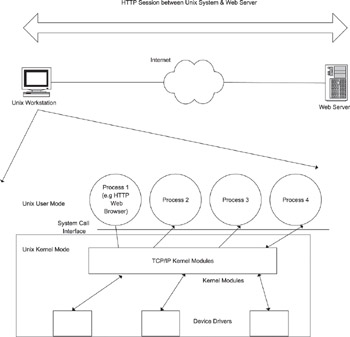
Hosts or end systems typically act as the source and destination for communications. When a user tries to access a Web site from a browser, the host computer uses the Hyper Text Transfer Protocol (HTTP) to communicate to a Web server typically another host system. The host system has a protocol stack comprising several of the layers in the OSI model. In the web browser, HTTP is the application layer protocol communicating over TCP/IP to the destination server, as shown in Figure 2.1.
Consider a UNIX -based host which provides the functionality of an end node in an IP network. In UNIX, there are two process modes user mode and kernel mode. User applications run in user mode, where they can be preempted and scheduled in or out. The operating...