Networking Explained

A fundamentals book about networking that will help novices as well as network pros.
 TABLE OF CONTENTS
 In this chapter we present an overview of token ring networks, IEEE 802.5. Unlike Ethernet/802.3 LANs in which nodes contend for media access, token ring LANs use a tokenpassing scheme; that is, media access in token ring LANs is controlled by the possession of a token. We discussed general issues relating to token passing, including a comparison of random-access and token-passing protocols, in Chapter 5, which you might want to review before proceeding. In addition to token ring, the IEEE standards include a second token-passing protocol called token bus. Although token bus use is uncommon, we present a brief comparison of the two token-passing schemes for completeness.
A token ring network is a local area network technology based on a token-passing protocol for media access control. Data frames on a token ring network are transmitted from node to node, in either a clockwise or counter-clockwise direction, over a point-to-point link. A token ring LAN is implemented either as a logical ring using a physical ring topology (see Figure 9-1), or as a logical ring structure arranged in a physical star configuration (see Figure 9-2). It is also possible to extend the configuration in Figure 9-2 to include a ring consisting of several interconnected hubs. This is shown in Figure 9-3, which describes the arrangement in the special language of token rings.
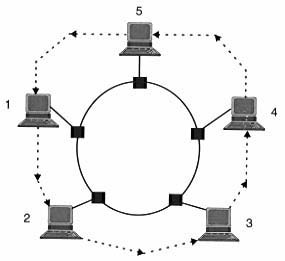
Figure 9-1: A token ring network consists of a logical ring implemented in a physical ring topology. A token, which is...