Networking Explained

A fundamentals book about networking that will help novices as well as network pros.
 TABLE OF CONTENTS
 In this chapter we present an overview of a network technology called Fiber Distributed Data Interface or FDDI. FDDI employs a ring topology, with fiber-optic cabling as its physical layer medium. We also discuss a "sister" standard called Copper Distributed Data Interface (CDDI), which uses copper instead of fiber.
FDDI stands for Fiber Distributed Data Interface. FDDI networks are described by ANSI standard X3T9.5 created in 1986 for interconnecting computer systems and network devices typically via a fiber ring topology at 100 Mbps. Figure 10-1 shows where FDDI networks fits in the hierarchy of network architectures. ( Note: For information about the other network architectures listed in this figure, see the appropriately named chapters.)
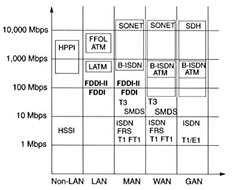
Figure 10-1: Schematic that shows how the various networking technologies compare against each other in terms of bandwidth.
FDDI's bandwidth gives it considerable flexibility in how an organization allocates its resources. Its applications include directly connecting workstations and servers in workgroups, and serving as a high-speed backbone to connect other networks in a building, in a campus environment, or in a city. An example of the first application is the interconnection of high-speed servers to other high-speed servers. For instance, a very large video server system cannot be effectively connected to a broadcast video server at 10 Mbps Ethernet/802.3 or token ring speeds, but at FDDI's data rate of 100 Mbps, the connection is adequate for server transmission. As a backbone network,...