Optimizing and Testing WLANs: Proven Techniques for Maximum Performance
Metrics and measurements pertinent to the wireless LAN (WLAN) Medium Access Control (MAC), as well as the Transmission Control Protocol (TCP)/Internet Protocol (IP) stack, are covered here. Protocol testing covers a wide swath of measurements: performance, conformance, functional and interoperability, as well as comparative benchmark testing. Most of the focus in this chapter is on WLAN MAC-level testing, including security.
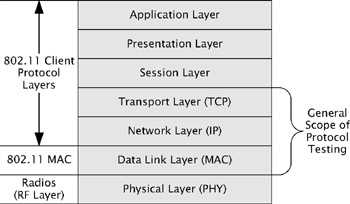
While technically the (RF) physical or PHY layer is considered a part of the WLAN protocol, in this context protocol testing refers to tests performed on device functions involving frames. Typically, when protocol tests are performed the PHY layer is assumed to be working and standards-compliant, and therefore no attempt is made to include it in the measurements. Thus protocol tests are aimed at the link layer (and above) of the ISO protocol stack, as indicated in the figure below.
It is not unusual to find functional tests being confused for performance measurements when performing protocol testing. However, the difference is important to understand.
A functional test is concerned with verifying that a device or system does something. For instance, a functional test might check to see that a WLAN device transmits frames that have properly formatted MAC headers and are without Frame Check Sequence (FCS) errors. (Conformance testing is a close cousin to functional testing, in that the test results are also usually binary-yes/no.) Even if a functional test produces numbers as the...