Practical VoIP Security

Written for the thousands of IT professionals who are now responsible for deploying and maintaining secure VoIP networks, this book covers evaluation, design, integration, and management of VoIP networking components.
 TABLE OF CONTENTS
 VoIP protocols can be classified according to their role during message transmission. H.323 and SIP are signaling protocols that is, they are involved in call setup, teardown, and modification. RTP and RTCP are media transport protocols, and are involved in end-to-end transport of voice and multimedia data. TRIP, SAP, STUN, TURN, and so on comprise a group of VoIP-related support protocols. Finally, because H.323 mediated VoIP relies upon the underlying transport layer to move data, more traditional protocols such as TCP/IP, DNS, DHCP, SNMP, RSVP, and TFTP are required.
The H.323 protocol suite allows dissimilar communication devices to communicate with each other. H.323 (which is implemented primarily at versions 4 and 5 as of the time of this writing) is a sometimes Byzantine international protocol published by the ITU that supports interoperability between differing vendor implementations of telephony and multimedia products across IP-based networks. H.323 entities provide for real-time audio, video, and/or data communications. Support for audio is mandatory; support for data and video is optional.
The H.323 specification defines four different H.323 entities as the functional units of a complete H.323 network (see Figure 5.1). These components of an H.323 system include endpoints (terminals), gateways, gatekeepers, and multipoint control units (MCUs).
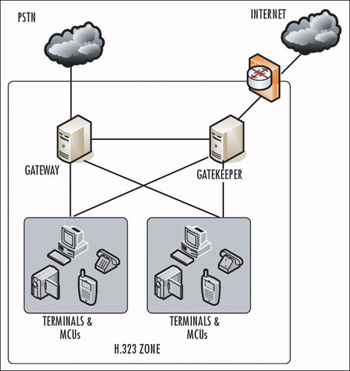
Endpoints (telephones, softphones, IVRs, voice mail, video cameras, etc.) are typically devices that end-users interact with. MS Netmeeting is an example of an H.323 endpoint. Endpoints provide voice-only and/or multimedia such as video and real-time application collaboration.
Gateways handle...