Security for Mobility
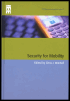
This text explains the importance of security in mobile devices, and covers current developments in security for mobility, underlying technologies, network security, mobile code issues, application security, and the future.
 TABLE OF CONTENTS
 G nther Horn, Valtteri Niemi, Kaisa Nyberg and Hannes Tschofenig
This chapter addresses security issues in future mobile communications systems, beyond the third generation currently being introduced in Europe under the name of Universal Mobile Telecommunications System (UMTS). A user in a future mobile communications system should be able to use services from anywhere in the system (global roaming), and when using these services, the particular access network technology should be transparent to the user. Finding a unique security solution that is largely independent of the potentially many different access technologies is a particular challenge that these future mobile systems pose. The security considerations presented in this article are based on the work of the EU-sponsored collaborative research project SHAMAN [1]. The results can be easily generalised to various types of future mobile systems. The concepts discussed in this chapter focus on the security features and mechanisms required to provide global IP connectivity and various forms of mobility to a globally roaming user in a future mobile system.
We currently see the deployment of so-called third-generation (or '3G') mobile telecommunications systems. In Europe, the underlying technology is known as UMTS. But researchers and engineers are already working on the generation of mobile telecommunications systems 'beyond 3G'. While there are still many open questions concerning the specifics of mobile systems beyond 3G, a vision of such systems is taking shape, cf., for example, [2]: 'The concept of Ambient Intelligence provides a vision of the Information Society where the emphasis is...