Simulation Engineering

In this text, the author delivers step-by-step instructions on the entire range of simulation techniques and sage insight into the related management issues.
 TABLE OF CONTENTS
 This section will discuss some techniques for developing the equations and data sets for a mathematical model. A model is "physics-based" if it is based on the equations of generally accepted physical laws. A spacecraft orbital model based on Newton's law of motion is an example of a physics-based model. Many systems have behavior that is too complex to represent in terms of the laws of physics. An example of this situation is the aerodynamic performance of a supersonic aircraft, which tends to be very nonlinear and difficult to represent using the equations of physics. In this case, the only reasonable approach for model development may be to measure the behavior of the system with a sub-scale model in a wind tunnel and use this data to create a set of interpolation tables. This approach leads to an "empirical" model.
Figure 2.2 shows a pendulum suspended from a string of length l under the influence of gravitational acceleration g. The pendulum angular deflection with respect to the vertical is q, given in radians. The mass of the pendulum bob is defined to be m. The goal for this model is to determine the period of oscillation of the pendulum as a function of the initial deflection angle q 0, assuming that the initial velocity  is zero.
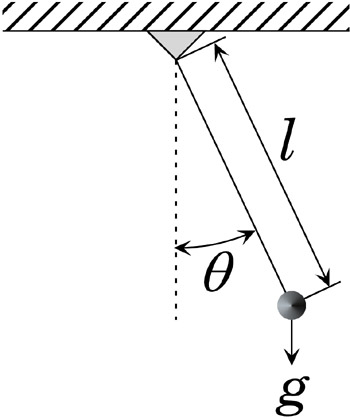
To determine the oscillation period, begin by considering which effects are significant.