Spacecraft Technology: The Early Years

Charting the early Space Age, from the launch of Sputinik 1 in 1957 to the landing of men on the Moon, this book is a celebration of the importance of that early technology in shaping our global culture.
 TABLE OF CONTENTS
 The world's first artificial satellite, Sputnik 1 (Figure 3.1), was launched on 4 October 1957 at 6.00 am Moscow time and the event was announced by Radio Moscow that evening. Sputnik was the Russian word for satellite, but is often more lyrically translated as traveller or fellow traveller [6].
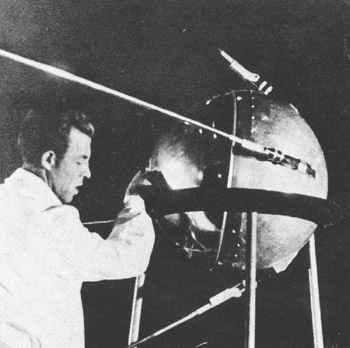
In Washington, at a reception for delegates of an IGY conference, Lloyd Berkner was able to congratulate the happy Russian contingent who, in typical style, pleaded ignorance of the details [7]. It soon became clear, however, that the launch of Sputnik 1 was a significant accomplishment: it was an aluminium-alloy sphere, measuring 58 cm in diameter and weighing 83.6 kg. Compared with anything America had planned, it was huge.
Many in the West found it hard to believe that the Soviet Union had managed to launch a satellite, but proof was provided by the Jodrell Bank radio telescope in England, which was brought quickly to operational status especially to track the mysterious object.
The launch took America in particular by surprise. Satisfied with its lead in many products of technology, from motor cars to the atom bomb, the nation found it difficult to believe that its superiority was threatened. Such was America's complacence that it had ignored a catalogue of announcements which could have prepared it for Sputnik:
As early as 1948, Colonel Gregory Tokayev, a Russian rocket expert who had sought refuge in England, expressed the conviction...