Spacecraft Technology: The Early Years

Charting the early Space Age, from the launch of Sputinik 1 in 1957 to the landing of men on the Moon, this book is a celebration of the importance of that early technology in shaping our global culture.
 TABLE OF CONTENTS
 As a result of delayed political commitment to a satellite launcher, and the failed attempt to launch a Vanguard in December 1957 (which the media characteristically dubbed Flopnik or Kaputnik [24]), America had to wait almost four months after the launch of Sputnik 1 to see its first satellite in orbit. That satellite, Explorer 1, was launched on 31 January 1958.
Since America's rockets were so much smaller and less powerful than the Soviet vehicles, its satellites too were significantly smaller and lighter. Thus Explorer 1 weighed just 8.2 kg, compared with Sputnik 1's 83.6 kg, although complete with the expended solid propellant rocket, the mass delivered to orbit by the Juno I launch vehicle was some 14 kg [25].
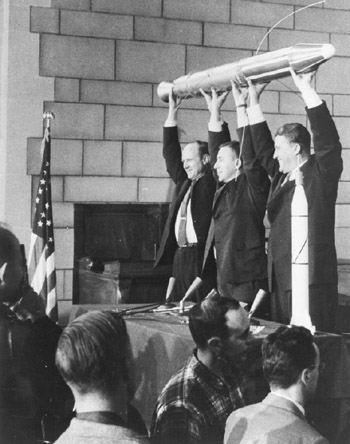
Interestingly, the seminal photograph showing William Pickering, James Van Allen and Wernher von Braun triumphantly holding aloft an engineering model of what is usually described as Explorer 1 in fact shows the satellite attached to its Baby Sergeant upper stage. A picture of this famous trio attempting to hold the 75 cm-long, 15.3 cm-diameter Explorer alone would have made a much less dramatic visual statement (Figure 3.3).
Despite its small size, Explorer 1 carried a reasonably advanced payload. Mounted...