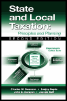
State and Local Taxation: Principles and Planning, Second Edition
Chapter 4: Sales and Use Taxes

Introduction

Sales taxes first came into being in the U.S. around the time of the Great Depression to overcome the shortfall in revenues from income and property taxes. In 1932, Mississippi was the first state to enact a sales tax having most of the features of sales taxes as we know them today. Many states quickly followed Mississippi's lead and enacted sales taxes of their own. Today, forty-five states and the District of Columbia have a tax that can be classified as a sales tax. The five states currently without a general retail sales tax at the state level are Alaska, Delaware, Montana, New Hampshire, and Oregon. However, throughout the 1990s, initiatives have been put forward before the electorates in these states to enact some type of a sales tax. For example, in November 1994, Oregon considered eliminating all state taxes in lieu of adopting a 2% "trade levy," which is more similar to a value-added or gross receipts tax. The proposal was defeated.

Although sales taxes typically are levied at the state level, many municipalities and other local subdivisions also impose sales taxes and these taxes are being used increasingly to supplement revenues from property taxes, the traditional source of revenues for local governments. An interesting example is Alaska, which does not have a state-level sales tax but has an extensive system of sales taxes at the local level. Many cities, such as Atlanta, Chicago, Los Angeles, New York, and Phoenix, also impose sales taxes of their own, which...

UNLIMITED FREE
ACCESS
TO THE WORLD'S BEST IDEAS

SUBMIT
Already a GlobalSpec user? Log in.

This is embarrasing...

An error occurred while processing the form. Please try again in a few minutes.

Customize Your GlobalSpec Experience

Category: Accounting and Financial Services
Finish!
Privacy Policy

This is embarrasing...

An error occurred while processing the form. Please try again in a few minutes.