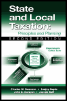
State and Local Taxation: Principles and Planning, Second Edition
Part IV: Other Areas

Chapter List

Chapter 10: Income Taxation of Employees and Sole Proprietorships

Introduction

Income taxation of employees and sole proprietorships has been saved until last in this book because the key issues were discussed when dealing with corporate income taxes. However, there are some corporate-individual differences, and these are presented in this chapter.

Federal-State Conformity

As with corporate income taxes, many states do not match Federal law, but increasingly have conformed. A key figure is Federal adjusted gross income, from which state differences are taken as adjustments in reaching state adjusted gross income. The biggest difference is grounded in differences in geographic jurisdiction. Analogous to the Federal, in some states income tax applies to the worldwide income of state residents but only the state-source income of nonresidents.

When it comes to personal income taxes, there are two basic sets of rules: the first for residents and the second for nonresidents and part-year residents. A "nonresident" is an individual who is not a resident; a person usually is a resident if physically present in the taxing jurisdiction for other than a "temporary or transitory purpose." As a rule of thumb, a person who moves into a state to take a job, start a business, or retire or who is physically present in the state for more than 9 months becomes a resident when he or she enters the state.

The distinction is made because in many states residents are taxed on their worldwide income but nonresidents are only taxed on...

UNLIMITED FREE
ACCESS
TO THE WORLD'S BEST IDEAS

SUBMIT
Already a GlobalSpec user? Log in.

This is embarrasing...

An error occurred while processing the form. Please try again in a few minutes.

Customize Your GlobalSpec Experience

Category: Legal Services
Finish!
Privacy Policy

This is embarrasing...

An error occurred while processing the form. Please try again in a few minutes.