1.4 Renewal Processes
We shall now introduce some functions which are directly related to the probability distribution function F( t), namely the reliability function R( t), the hazard function ?( t), and the cumulative hazard function which represent quantitative measures in different areas such as reliability, life data analysis, management, economics, etc. Recall that the reliability function, which was introduced in Section 1.2, is given by
It is also known as the survival function, and represents the probability that a device does not fail in the time interval (0, t].
The hazard function ?( t) represents the conditional probability of failure during a very small time increment under the assumption that no failures have occurred prior to that time.
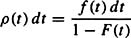
The term
represents the conditional probability of failure within the interval t and t + dt, given that the system is in operating state at time t. This function, which is a transformation of the survival function R( t), is also called the failure rate, the conditional failure, the intensity, or the force of mortality function. Some examples related to the calculation of the hazard rate are given in Chapter 2.
This function has been initially introduced for modelling optimization problems concerning maintenance and replacement of unreliable machines [34]. In fact, even though probabilities are involved, this optimization problem becomes a deterministic one. The use of hazard function has been extended to other modelling problems, as...


 TABLE OF CONTENTS