Stochastic Processes: Estimation, Optimization & Analysis
In this appendix we quote a number of results dealing with inequalities, lemmas and theorems. A knowledge of these results will be useful in the analysis of recursive stochastic algorithms.
We start by presenting a set of inequalities.
Triangle inequality A basic and commonly used inequality is certainly the triangle inequality for real numbers, i.e.,
To prove (A.1), it is enough to consider the four different cases (x, y ? 0;x ? 0, y ? 0;x ? 0, y ? 0, and x, y ? 0).
By taking the expectation on both sides of the triangle inequality (A.1), for real numbers, we derive
Based on this inequality, it is easy to verify that
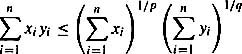
Now we shall present the H lder inequality.
H lder inequality Let p and q be two real numbers greater than 1 such that
then
where x i and y i ( i = 1,..., n) are positive numbers.
| Proof | Let a and b be two strictly positive real numbers, and define ? and ? as follows: From the convexity property of the exponential function and condition (A.4) we derive: and in view of (A.5), we get Consider now 2 n positive numbers x 1, ..., x n and y 1, ..., y n, and let then from (A.6) and for each i ( i = 1, ..., n), we obtain |