Understanding Credit Derivatives and Related Instruments
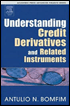
Chapter 5: Asset Swaps

Asset swaps are a common form of derivative contract written on fixed-rate debt instruments. The end result of an asset swap is to separate the credit and interest rate risks embedded in the fixed-rate instrument. Effectively, one of the parties in an asset swap transfers the interest rate risk in a fixed-rate note or loan to the other party, retaining only the credit risk component. As such, asset swaps are mainly used to create positions that closely mimic the cash flows and risk exposure of floating-rate notes.

5.1 A Borderline Credit Derivative

There is some disagreement among credit derivatives market participants on whether an asset default swap is a credit derivative. Some apparently focus on the fact that the asset swap can be thought of as not much more than a synthetic floater, and a floater is definitely not a credit derivative. Others seem to emphasize the fact that asset swaps can be thought of as a way to unbundle the risks embedded in a fixed-rate security, isolating its credit risk component, much like what other credit derivatives do. For these and other reasons, the difference in opinions regarding asset swaps persists. Indeed, while Risk Magazine s 2003 Credit Derivatives Survey (Patel, 2003) decided to exclude asset swaps from its range of surveyed products, the 2002 British Bankers Association Credit Derivatives Report included assets swaps in its credit derivatives statistics. The BBA acknowledged the ongoing debate among market participants, but reported that a majority of key participants considers...

UNLIMITED FREE
ACCESS
TO THE WORLD'S BEST IDEAS

SUBMIT
Already a GlobalSpec user? Log in.

This is embarrasing...

An error occurred while processing the form. Please try again in a few minutes.

Customize Your GlobalSpec Experience

Category: Digital Asset Management Software
Finish!
Privacy Policy

This is embarrasing...

An error occurred while processing the form. Please try again in a few minutes.