Visual Basic for Network Applications
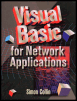
Learn how to add network functionality to your Visual Basic applications.
 TABLE OF CONTENTS
 In the rest of the book I describe the methods of accessing network resources (such as drives and printers) from within Visual Basic. Some methods use standard VB controls, others resort to the Windows API, but all are covered. I have also covered the main task that VB is used for in a network environment: electronic mail. So far, all these features can be accessed by any user with most versions of VB including 16-bit VB and VB 5.
However, before launching into the problems of LAN programming, I will use the luxury of this chapter to explain the way in which you can configure your Windows network resources so that you can make the most of them inside VB. Once you have created your network application, you'll need to distribute it over the network; the second half of this chapter is dedicated to the problems of distributing your application over a LAN.
Windows 95 supports a number of different network client types straight from the box; it includes network client software that allows Windows to use the network resources offered by the networks. Together with these network clients, Windows also supports a range of network protocols that define the way data is transferred over the network. By default, there is support for NetBEUI (Microsoft's own), IPX (Novell), TCP/IP (for Unix and Internet), VINES (for Banyan networks), PATHWORKS (for DEC systems), and DLC (for IBM computers). The range of network clients supported are: