From COBOL to OOP

Written for the experienced COBOL programmer, this nuts and bolts guide offers a comprehensive introduction to OOP techniques, and provides a migration of 10 million lines of COBOL code to object-oriented programming.
 TABLE OF CONTENTS
 Core problem: looking for exact description
This part of our OOP course deals with general basics and the language differences as a good starting point for our study of object orientation. We provide this explanation before describing the actual object-oriented concept to ensure that we can later concentrate on this core area without dealing with less important stuff, such as loops or variable declarations. Therefore, not everything shown in this chapter is really object-oriented, but all are necessary to work with our chosen languages, Delphi and Java.
Programming means that we have to describe a problem exactly so that a computer can understand it. This holds true in the world of COBOL programming just as in the world of object-oriented programming. In this context, a program consists of data (or Data Division in COBOL lingo) and commands (Procedure Division). It is important to note that data are maintained in a memory and that this memory can be represented as a set of addressable cells. In other words, these cells can be symbolically represented by little boxes (Figure 3.1). We will frequently refer to this representation in this book.
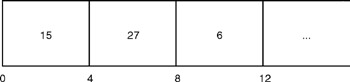
However, as we will see in the following sections, some data and commands are unified in object-oriented programming. Initially, a program is only a gradual sequence of processes, where each step has to be precise and unambiguous (for example, "wait a little" would not meet these criteria).
No breaking news...