Ground Penetrating Radar, 2nd Edition

12.3: Performance and Test Assessment

12.3 Performance and Test Assessment

The key issue with any sensor for mine detection including GPR is the probability of detection and false alarm rate. The key to this issue is the statistical confidence with which the claims of a particular hardware design, algorithm or software, sensor or combination of sensors performs. For this reason it is appropriate to explore some of the issues related to this topic.

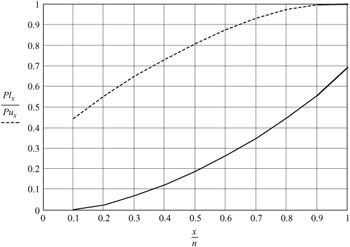
Elementary statistical sampling theory can be used to show that the confidence that can be placed in a test of a limited sample set is fundamentally related to the size of the sample set. If 10 mines are tested and even if all are detected (a probability of detection of 100%), the statistical confidence in the claim is limited by the number in the set. At the 95% limit, the upper and lower confidence bounds can be derived from the binomial distribution to show that, with a sample set of 10, the bounds as shown in Figure 12.2 exist. The x-axis shows the proportion of the sample set detected, and the y-axis shows the probability of detection.


Figure 12.2: Upper and lower confidence bounds for a sample set of 10 (binomial distribution)

In contrast, the limits for a sample set of 100 are much closer and are shown in Figure 12.3. These values are based on the small sample interval for calculating confidence intervals, and a Mathcad programme is provided to calculate limits based on the binomial distribution.

UNLIMITED FREE
ACCESS
TO THE WORLD'S BEST IDEAS

SUBMIT
Already a GlobalSpec user? Log in.

This is embarrasing...

An error occurred while processing the form. Please try again in a few minutes.

Customize Your GlobalSpec Experience

Category: Opacity Sensors and Instruments
Finish!
Privacy Policy

This is embarrasing...

An error occurred while processing the form. Please try again in a few minutes.