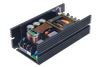
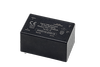
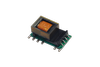
Switching power circuits, such as power DC/DC converters, power pulse-width-modulation (PWM) DC/AC inverters, soft-switching converters, resonant rectifiers and soft-switching AC/AC matrix converters, have pumping filtering process, resonant process and/or voltage-lift operation. These circuits consist of several energy-storage elements. They are likely an energy container to store certain energy during performance. The stored energy will vary if the working condition changes. For example, once the power supply is on, the output voltage starts from zero since the container is not filled. The transient process from one steady state to another depends on the pumping energy and stored energy. Same reason affects the interference discovery process since the stored energy, similar to inertia, affects the impulse response.
All switching power circuits work under the switching condition with high frequency f. It is thoroughly different from traditional continuous work condition. The obvious technical feature is that all parameters perform in a period T = 1/ f, then gradually change period-by-period. The switching period T is the clue to investigate all switching power circuits. Catching the clue, we can define many brand new concepts (parameters) to describe the characteristics of switching power circuits. These new factors fill in the blanks of the knowledge in power electronics and conversion technology. We will carefully discuss the new concepts and their applications in this chapter.
2.1 INTRODUCTION
From the introduction in previous chapter, we have got the impression of the four important factors: power factor ( PF), power transfer efficiency ( ?),...
Copyright Elsevier (USA) 2005 under license agreement with Books24x7

 TABLE OF CONTENTS