Digital Power Electronics and Applications
Open-loop control is the main control scheme for all digital control systems. Actually, a large number of the industrial applications of the converters are open-loop control systems. We have to carefully discuss these problems in this chapter.
Digital control for the power electronics, especially for the switching circuits control, is the purpose of this book. We will discuss the fundamental problems in four main converters: AC/DC rectifiers, DC/AC inverters, DC/DC converters and AC/AC (and AC/DC/AC) converters. These problems are:
Stability analysis
Unity-step responses
Impulse (interference) responses
These three main basic problems are the general characteristics of all control systems, including all digital control systems.
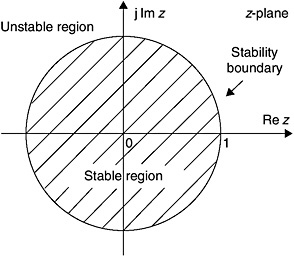
Stability is one of the most important problems of the digital control systems. The fundamental stability criterion is zero-pole location adjustment. If a digital control system has all poles inside the unity-cycle in the z-plane, the system is stable. This stability criterion is demonstrated in Figure 9.1. The stable region is inside the unity-cycle and the unstable region is outside the unity-cycle. If the pole is located on the cycle, it is the critical state of the stability.
Other stability criteria such as the Jury criterion are based on the theory. We will concentrate the fundamental method to judge our systems.
Stability of the digital control systems is also possibly adjusted in the s-domain. Considering the relation:
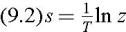
Solving for s in Equation (9.1), we obtain:
where T