Leveraging WMI Scripting: Using Windows Management Instrumentation to Solve Windows Management Problems

The WBEM provider exposes the WMI configuration parameters. The three classes supported by this provider are listed in Table 3.1.
| Name | Type | Comments |
|---|---|---|
| Win32_WMISetting | Dynamic (Singleton) | Contains the operational parameters for the WMI service. |
| Win32_WMIEIementSetting | Association | Association between a service running in the Win32 system, and the WMI settings it can use. |
| Win32_MethodParameterClass | Abstract | Abstract, base class that implements method parameters derived from this class. |
You can use the LoadCIMInXL.wsf script (see Sample 4.32 in the appendix) or the WMI CIM Studio of the Platform SDK to gather more information about the class properties. In the Platform SDK, these classes are classified as the WMI System Management classes.
The WBEM provider classes are available in the Root\CIMv2 namespace. Basically, the Win32_WMISetting class gives access to the WMI settings available from the WMI Control MMC (in the Computer Management MMC). Since there is one installation of WMI per system, there is only one instance of the Win32_WMISetting class. This is the reason why this class has no Key property defined in its properties and is therefore defined as a singleton class.
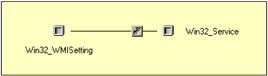
Because this class relates to one WMI installation in one system, the Win32_WMIElementSetting class associates the Win32_WMISetting with the Win32_Service class (see Figure 3.1). The Win32_WMISetting has one Windows associated service instance: the WinMgmt.Exe service.
The Win32_MethodParameterClass