Leveraging WMI Scripting: Using Windows Management Instrumentation to Solve Windows Management Problems

The Disk quota provider is made up of only one instance provider (see Table 3.42) supporting three classes. This provider is designed to expose information about quota settings configured on NTFS volumes.
| Provider Name | Provider Namespace | Class Provider | Instance Provider | Method Provider | Property Provider | Event Provider | Event Consumer Provider | Support Get | Support Put | Support Enumeration | Support Delete | Windows Server 2003 | Windows XP | Windows 2000 Server | Windows 2000 Professional | Windows NT 4.0 |
|---|---|---|---|---|---|---|---|---|---|---|---|---|---|---|---|---|
| Disk Quota Provider | ||||||||||||||||
| DskQuotaProvider | Root/CIMV2 | X | X | X | X | X | X | X |
It supports one dynamic instance class and two association classes, as shown in Table 3.43.
| Name | Type | Comments |
|---|---|---|
| Win32_QuotaSetting | Dynamic | Contains setting information for disk quotas on a volume. |
| Win32_DiskQuota | Association | Tracks disk space usage for NTFS volumes. |
| Win32_VolumeQuotaSetting | Association | Relates disk quota settings with a specific disk volume. |
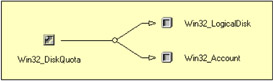
These classes are available in the Root\CIMv2 namespace. The Win32_ DiskQuota association class associates the Win32_LogicalDisk class with the Win32_Account (see Figure 3.19).
With this association, it is possible to view and configure different quotas per user. We will exploit this capability in the next script sample. On the other hand, the Win32_QuotaSetting class is associated with...