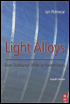
Light Alloys: From Traditional Alloys to Nanocrystals, Fourth Edition
The term light metals has traditionally been given to both aluminium and magnesium because they are frequently used to reduce the weight of components and structures. On this basis, titanium also qualifies and beryllium should be included although it is little used and will not be considered in detail in this book. These four metals have relative densities ranging from 1.7 (magnesium) to 4.5 (titanium) which compare with 7.9 and 8.9 for the older structural metals, iron and copper, and 22.6 for osmium, the heaviest of all metals. Ten other elements that are classified as metals are lighter than titanium but, with the exception of boron in the form of strong fibres contained in a suitable matrix, none is used as a base material for structural purposes. The alkali metals lithium, potassium, sodium, rubidium and caesium, and the alkaline earth metals calcium and strontium are too reactive, whereas yttrium and scandium are comparatively rare.
The property of lightness translates directly to material property enhancement for many products since by far the greatest weight reduction is achieved by a decrease in density (Fig. 1.1). This is an obvious reason why light metals have been associated with transportation, notably aerospace, which has provided great stimulus to the development of light alloys during the last 50 years. Strength: weight ratios have also been a dominant consideration and the central positions of the light alloys based on aluminium, magnesium and titanium with respect both...