As a general average, 75 to 80% of aluminium is used for wrought products, e.g. rolled plate (>6 mm thickness), sheet (0.15 6 mm), foil (<0.15 mm), extrusions, tube, rod, bar and wire. These are produced from cast ingots, the structures of which are greatly changed by the various working operations and thermal treatments. Each class of alloys behaves differently, with composition and structure dictating the working characteristics and subsequent properties that are developed. Relationships between the various wrought alloy systems are summarised concisely in Fig. 3.1. Before considering each system individually, it is desirable to examine how wrought alloys are produced and processed.
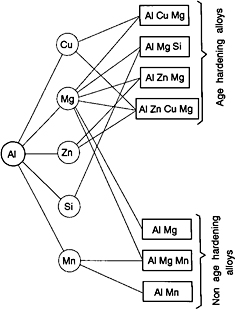 Fig. 3.1: Representation of alloying relationships of the principal wrought aluminium alloys (courtesy D. G. Altenpohl).
 3.1 PRODUCTION OF WROUGHT ALLOYS
3.1.1 Melting and casting
Ingots are prepared for subsequent mechanical working by first melting virgin aluminium, scrap and the alloying additions, usually in the form of a concentrated hardener or master alloy, in a suitable furnace. A fuel-fired reverberatory type is most commonly used. The main essentials in promoting ingot quality are a thorough mixing of the constituents together with effective fluxing, degassing, and filtering of the melt before casting in order to remove dross, oxides, gases and other non-metallic impurities. Hydrogen is the only gas with measurable solubility in aluminium, the respective equilibrium solubilities in the liquid and solid states at the melting temperature and a pressure of one atmosphere being 0.68 and 0.036 cm 3 per 100 g of metal a difference of 19...
Copyright I. J. Polmear 2006 under license agreement with Books24x7


 TABLE OF CONTENTS