Limit Analysis & Soil Plasticity
Devoted to the theory and applications of limit analysis as applied to soil mechanics, this text also contains information on soil plasticity and rock-like material such as concrete.
 TABLE OF CONTENTS
 In deriving the slipline solutions, the soil is assumed to be a rigid-plastic material in which slip or yielding occurs in plane strain when the stresses satisfy the Coulomb criterion, in the usual notation:

This equation and the two equations of stress equilibrium:
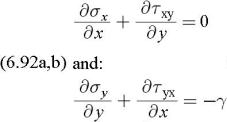
form a hyperbolic system of equations for the determination of the stresses ? x, ? y and ? xy. Since there are the same number of equations as unknown stress components, [6.91] and [6.92] are often sufficient to make the stresses statically determinate without considering a stress-strain relation of soil. Most of the bearing capacity problems considered here are statically determinate in this sense. In general, however, in many problems the boundary conditions involve rates of displacement, the stress boundary conditions above are not sufficient to make these problems statically determinate and the use of a stress-strain relation is necessary in order to obtain solutions of such problems. The term static determinacy in such cases is then misleading.
Referring now to Fig. 4.12(a), the two slip lines (or characteristic lines) are inclined at an angle ( ? ? ?) to the direction of the maximum compressive stress ? max and will be called the first and second slip lines, with the convention that the direction of the first slip line is obtained from the direction of ? max by a counterclockwise rotation of amount...