Information Modeling and Relational Databases: From Conceptual Analysis to Logical Design
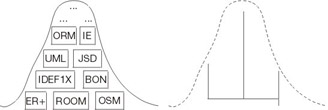
Although semantic approaches to information modeling appeared in the early 1970s, no single approach has yet achieved universal adoption. By and large, the history of information systems modeling has been characterized by a plethora of techniques and notations, with occasional religious wars between proponents of different approaches. Each year, dozens of new approaches would be proposed, leading to groans from the academic community who were charged with teaching the state of the art. This is referred to as the yama (Yet Another Modeling Approach!) or nama (Not Another Modeling Approach!) syndrome. Figure 9.1 pictures this as a mountain of modeling methods, piled on top of one another, which nicely ties in with the Japanese meaning of yama (mountain), depicted as a kanji that is high in the middle and low on the ends.
While diversity is often useful, clearly the modeling industry would benefit if practitioners agreed to use just a few standard modeling approaches, individually suited for their modeling scope, and collectively covering the tasks needed to model a wide variety of practical applications. This would improve communication between modelers and reduce training costs, especially in an industry with high turnaround of employees.
Recently, the rapid rise of UML (Unified Modeling Language) has been accompanied by claims that UML by itself is an adequate approach for modeling any software application. Some UML proponents have even been so bold as to claim that the modeling wars...