Intelligent Control Systems using Computational Intelligence Techniques

2.2: Model architectures

2.2 Model architectures

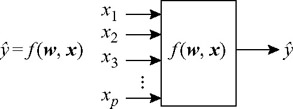
For system identification applications, artificial neural networks (Figure 2.1) can be envisaged as a model that performs a nonlinear transformation between a p-dimensional input space and a one-dimensional output space.


Figure 2.1: Neural model

The model is, in a first instance, characterised by w parameters and a certain structure, both of which need to be determined. In all neural networks described in this chapter, according to the type of dependence of the output in the model parameters, these can be decomposed into two classes: linear and nonlinear.

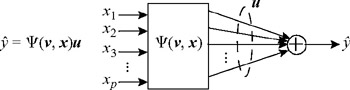
In Figure 2.2, u is a vector of l linear weights, ? is a vector of l basis functions and v is a vector of nonlinear weights. In a neural network, all the basis functions are of the same type, or can all be obtained from the same elementary function. Each basis function is p-dimensional, and is constructed using a unidimensional function. According to the construction method and the function used, the different model types are obtained.


Figure 2.2: Model with parameter separability

2.2.1 Multilayer perceptrons

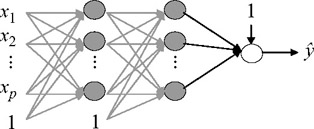
In multilayer perceptrons (MLPs) [6] (Figure 2.3) the nonlinear neurons are grouped into one or two hidden layers.


Figure 2.3: MLP network

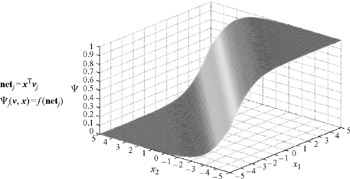
The nonlinear neurons use a sigmoidal-type unidimensional function, and the construction method employed consists in projecting the input vector over the nonlinear weight vector associated with each basis function (Figure 2.4).


Figure 2.4: Nonlinear neuron of an MLP network

It should be noticed...

UNLIMITED FREE
ACCESS
TO THE WORLD'S BEST IDEAS

SUBMIT
Already a GlobalSpec user? Log in.

This is embarrasing...

An error occurred while processing the form. Please try again in a few minutes.

Customize Your GlobalSpec Experience

Category: Boiler Controllers
Finish!
Privacy Policy

This is embarrasing...

An error occurred while processing the form. Please try again in a few minutes.