Intelligent Control Systems using Computational Intelligence Techniques

When the process to be modelled has dynamics, the model should reflect this fact. There are essentially two approaches for that: to use models with external dynamics or to employ models with internal dynamics.
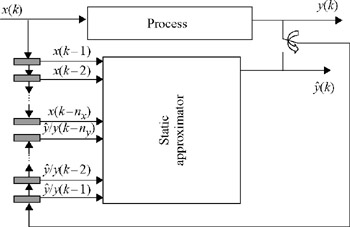
Models with external dynamics can be considered as static nonlinear approximators, whose inputs are obtained through the application of time-delay lines (see Figure 2.10). If the aim is to use the model for simulation, then the switch is connected to the model output. In the context of neural networks, this is called a parallel configuration. If the model is used for prediction, then the switch is connected to the process output, and this is called a series parallel configuration [67].
As with linear dynamic models, there are several nonlinear model structures available. For a detailed description of the latter, the reader can refer to [68]. Concerning the former, [34] is recommended.
All these models can be expressed as:
where the regression vector ?[ k] contains the current and past inputs, possibly past (model or process) outputs, and eventually past prediction errors.
In the case when the regression values only contain inputs, we have models without output feedback. To obtain a good model, a large number of regressors is needed, which is translated into a greater model complexity. For these reasons they are seldom used.
The most common nonlinear structures are:
The NARX model...