IP Addressing and Subnetting Including IPv6
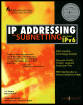
A clear, comprehensive guide to IP addressing, including technical details on IP message formats and standards.
 TABLE OF CONTENTS
 This chapter covers Network Address Translation (NAT). In its simplest form, NAT changes network layer (layer 3) addresses as they pass through some device, such as a router or firewall. In theory, other layer 3 protocols can be translated, such as AppleTalk or IPX, as well as other layers (such as layer 2). In practice, it's usually done only with IP addresses at layer 3. Because this is a TCP/IP book, this chapter will focus exclusively on IP.
We will demonstrate, however, that simply changing the layer 3 address is insufficient, and that transport layer (layer 4), and often higher layer, information must also be affected. Therefore, our discussion will also include TCP and UDP, as well as application layer (layer 7) protocols. We will discuss not only what NAT is and how it works, but also what the problems and shortcomings are.
This chapter is not about network security; however, the issues surrounding NAT often intersect with those of security applications. In some cases, particular types of NAT make the most sense in the context of a security application. Many of the commercial NAT implementations are part of a security package. Given that, we will be covering some security information as it relates to NAT, though NAT by itself is not necessarily security technology.