Manufacturing Engineering Modular Series: Manufacturing Information and Data Systems
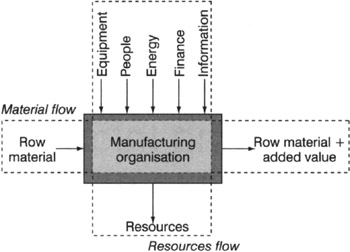
The role of a manufacturing organization can be seen as the generation of resources, generally financial, to add value to raw materials, then called finished products, for which there is a demand. In order to achieve this transformation process, the manufacturing organization uses a number of resources in the shape of equipment, people, information, energy and finance. If, over the lifetime of the company, the cost of the resources used is lower than the revenue brought in by the resources generated, the company is seen as being successful. Consequently, from a macroscopic point of view, a manufacturing organization can be represented as a system at the intersection of a materials flow and a resources flow (Figure 1.1). The resources flow contains the information that is one of the basic needs of a manufacturing organization. Typical examples of information contained in this flow would be customer orders, legislation and request for payment. This information will in turn trigger further creation of information flows within the organization.
The information needs of a manufacturing organization are therefore clear from a macroscopic point of view since information constitutes one of the key external resources on which the organization has to rely in order to perform its functions. It can be assumed that in most cases the outgoing resources flow will also contain a certain amount of information, but other than in specific cases, this...